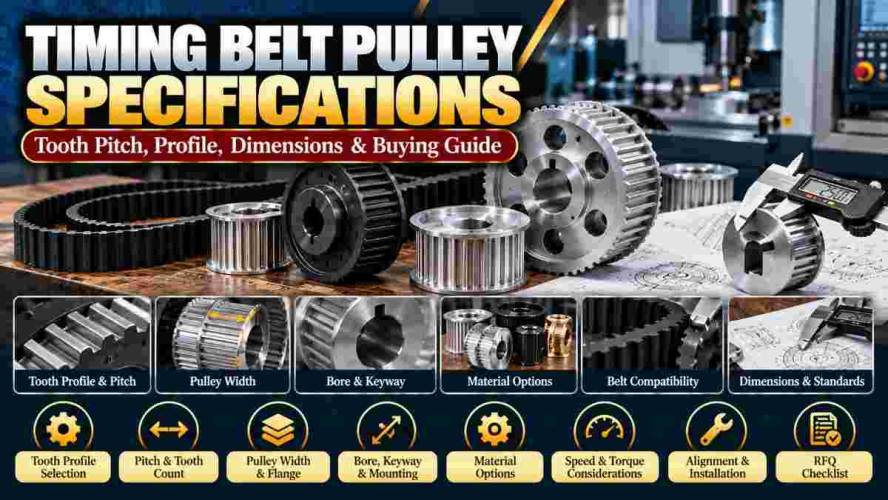
Are you replacing a worn timing pulley or selecting components for a new industrial machine? Ordering the wrong pulley can cause belt misalignment, premature wear, vibration, and production interruptions.
The most important timing belt pulley specifications include tooth profile, tooth pitch, number of teeth, pulley width, bore diameter, keyway dimensions, materials, and operating speed.
These details determine whether the pulley is compatible with the timing belt and suitable for the machine's power transmission requirements.
Anant Engineering offers industrial timing belt pulleys and related power transmission components for machinery applications.
What Is an Industrial Timing Belt Pulley?
An industrial timing belt pulley is a toothed wheel designed to engage a compatible synchronous belt and transmit rotational motion without the normal slip associated with friction-based belt drives.
Common applications include:
-
Packaging machines.
-
CNC equipment.
-
Industrial automation.
-
Printing machinery.
-
Conveyor drives.
-
Manufacturing equipment.
Explore Timing Belt Pulleys for available product information.
Why Are Timing Belt Pulley Specifications Important?
Correct specifications ensure that the pulley and belt engage properly while meeting the machine's speed, load, and dimensional requirements.
Incorrect selections may lead to:
Pulley selection should follow the approved machine design and belt manufacturer's recommendations.
What Is Tooth Pitch in a Timing Belt Pulley?
Tooth pitch is the distance between corresponding points on adjacent teeth measured along the pulley's pitch circle.
Common timing belt systems use different pitch families, including metric and inch-based designs.
The pulley pitch must match the selected belt.
Two pulleys with similar outside diameters may use completely different tooth pitches.
How Do You Choose the Correct Timing Pulley Tooth Profile?
Choose a tooth profile specifically designed for the timing belt being used.
Common profile families include:
These designs are not automatically interchangeable, even when their nominal pitch appears similar.
Check the belt's exact designation before ordering.
How Does Pulley Tooth Count Affect Speed Ratio?
Pulley tooth count determines the rotational speed relationship between the driving and driven shafts in a synchronous belt system.
For a conventional two-pulley drive:
Speed Ratio = Driven Pulley Teeth ÷ Driving Pulley Teeth
For example, a driven pulley with twice as many teeth as the driving pulley rotates at approximately half the driving speed.
The pulley combination must also meet the belt manufacturer's minimum tooth-count and engagement requirements.
What Is the Difference Between Pitch Diameter and Outside Diameter?
Pitch diameter refers to the theoretical pitch circle used for belt engagement calculations, while outside diameter describes the pulley's physical outer measurement.
These dimensions are not interchangeable.
For replacement pulleys, provide the specified tooth profile, pitch, tooth count, and measured dimensions.
Do not identify a timing pulley using outside diameter alone.
How Do You Select the Correct Timing Pulley Width?
Pulley width should accommodate the selected timing belt and any necessary lateral guidance without restricting belt movement.
Important measurements include:
Use the belt manufacturer's recommended pulley dimensions.
Why Are Bore Diameter and Keyway Dimensions Important?
Bore diameter and keyway specifications determine how the pulley fits and transmits torque through the shaft connection.
Check:
-
Shaft diameter.
-
Bore tolerance.
-
Keyway width and depth.
-
Hub length.
-
Locking arrangement.
-
Shaft-end clearance.
Some applications use taper-lock bushings or other shaft-locking systems.
Explore Taper Lock Pulleys for related product information.
Which Materials Are Suitable for Industrial Timing Belt Pulleys?
Timing pulley materials should be selected according to transmitted torque, operating speed, wear requirements, weight, and environmental exposure.
Common materials include:
Material suitability depends on the pulley geometry and operating conditions.
Confirm the available material options with the supplier.
How Do Torque and Operating Speed Affect Pulley Selection?
Torque and speed influence the pulley size, tooth loading, shaft connection, and suitability of the complete belt drive.
Important details include:
A pulley should not be approved solely because its dimensions match an existing component.
Why Is Pulley Alignment Important?
Correct pulley alignment helps maintain consistent belt tracking, reduce uneven wear, and limit unnecessary loads on bearings and shafts.
Check:
-
Shaft parallelism.
-
Pulley positioning.
-
Axial alignment.
-
Bearing condition.
-
Belt tension.
-
Mounting stability.
Follow the drive manufacturer's installation tolerances.
How Can You Identify a Worn Timing Belt Pulley?
Common warning signs include tooth wear, damaged flanges, corrosion, excessive vibration, and unusual belt tracking.
Inspect for:
-
Worn or damaged teeth.
-
Surface cracks.
-
Loose mounting hardware.
-
Damaged keyways.
-
Flange deformation.
-
Abnormal belt wear.
-
Excessive noise.
Inspect the belt and associated drive components before replacing the pulley.
What Should You Check Before Ordering a Replacement Pulley?
A replacement pulley must match the original drive's tooth geometry, dimensions, shaft connection, and operating requirements.
Check the existing belt designation, pulley tooth count, pitch, width, bore, hub, keyway, and flange configuration.
Provide technical drawings or a sample wherever possible.
What Factors Affect Timing Belt Pulley Prices?
Timing pulley prices depend on dimensions, tooth profile, material, manufacturing complexity, shaft connection, and order quantity.
Important cost factors include:
Compare quotations using consistent specifications.
What Should You Include in a Timing Belt Pulley RFQ?
A complete RFQ should identify the belt system, pulley geometry, shaft dimensions, operating conditions, and required quantity.
Include:
-
Timing belt profile and pitch.
-
Number of pulley teeth.
-
Required belt width.
-
Pulley face width.
-
Bore diameter.
-
Hub dimensions.
-
Keyway specifications.
-
Flange requirements.
-
Preferred material.
-
Operating speed and torque.
-
Drawing or existing sample.
-
Quantity and delivery location.
Accurate specifications help avoid incorrect replacement components.
Why Should Buyers Consider Anant Engineering?
Anant Engineering offers timing belt pulleys and related industrial power transmission products for machinery applications.
Its product range includes timing belt pulleys, V-belt pulleys, taper-lock pulleys, and flat belt pulleys.
Explore Timing Belt Pulleys for product details.
Confirm exact tooth profiles, dimensions, materials, tolerances, and availability before placing an order.
What Are the Most Frequently Asked Questions About Timing Belt Pulleys?
Common questions concern tooth pitch, pulley compatibility, sizing, materials, and replacement requirements.
Can Timing Belt Pulleys With the Same Pitch Be Interchanged?
Not necessarily. Tooth profile and manufacturer-specific geometry must also be compatible.
Does the Number of Pulley Teeth Affect Speed?
Yes. The driving and driven pulley tooth counts determine the theoretical transmission ratio.
Can Timing Belt Pulleys Be Customized?
Custom bores, hub dimensions, materials, and other features may be available depending on manufacturing capabilities.
Are Timing Belt Pulleys Suitable for Precision Machines?
Yes, when the belt drive is correctly designed for positioning requirements, loads, tension, and operating conditions.
Should a Damaged Timing Belt Pulley Be Replaced?
A pulley with safety-critical damage or unacceptable tooth wear should be assessed and replaced as required by the equipment manufacturer.
How Can You Request Industrial Timing Belt Pulleys From Anant Engineering?
You can request a timing belt pulley quotation by sharing the tooth profile, pitch, tooth count, belt width, bore, keyway, material, and quantity.
For replacement applications, include photographs, an approved drawing, or an original component.
Explore Timing Belt Pulleys or contact Anant Engineering for product enquiries and quotations.
Technical Note: Final pulley and belt selection must follow the approved equipment design, applicable manufacturer specifications, and verified torque, speed, and installation requirements.

 Industrial Couplings
 Industrial Gears
 Sprocket
 Industrial Roller Chain
 Pulleys
 Plummer Block
 Gearbox