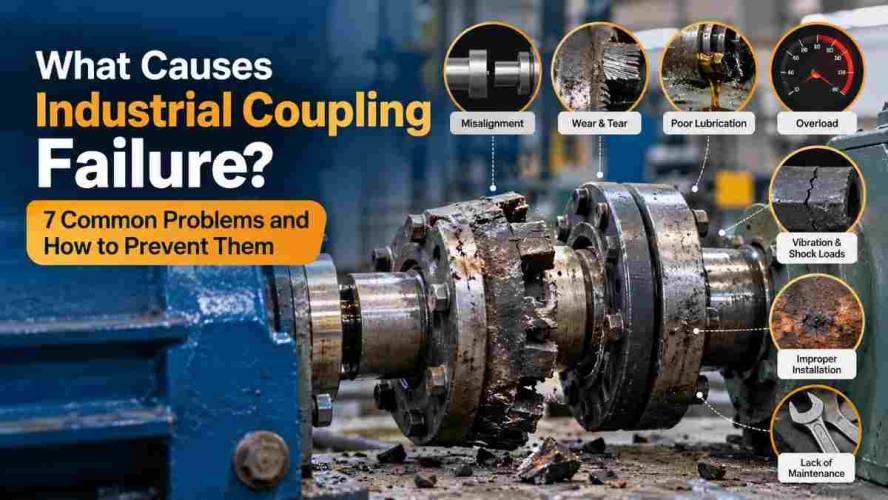
Industrial couplings play a critical role in transferring torque between rotating shafts in motors, pumps, gearboxes, conveyors, compressors and other machinery.
Although couplings are designed to operate under demanding conditions, they can still fail prematurely when they are incorrectly selected, poorly installed or inadequately maintained.
An industrial coupling failure can lead to excessive vibration, shaft damage, bearing wear, unexpected machinery downtime and increased maintenance costs.
Understanding the most common coupling failure causes can help maintenance teams identify problems before they turn into serious equipment failures.
In this guide, we look at seven common reasons industrial couplings fail and what can be done to prevent them.
What Are the Common Signs of Industrial Coupling Failure?
Coupling problems usually develop gradually before complete failure occurs.
Some warning signs include:
-
Excessive machinery vibration
-
Unusual noise from the coupling area
-
Increased bearing temperature
-
Visible coupling wear
-
Damaged flexible elements
-
Loose bolts or fasteners
-
Lubricant leakage
-
Uneven tooth wear
-
Shaft movement
-
Repeated alignment problems
These symptoms should not be ignored.
A coupling that continues operating under abnormal conditions may eventually damage surrounding components such as shafts, bearings, motors and gearboxes.
1. Can Shaft Misalignment Cause Coupling Failure?
Yes. Shaft misalignment is one of the most common causes of shaft coupling failure.
Misalignment occurs when the driving and driven shafts are not positioned correctly relative to each other.
Three common forms of misalignment are:
Flexible couplings are designed to accommodate limited amounts of misalignment, but every coupling has an allowable operating range.
If the misalignment exceeds that limit, additional forces are transferred through the coupling.
This can increase wear on:
-
Coupling teeth
-
Flexible inserts
-
Bushes
-
Bearings
-
Shaft seals
-
Connected machinery
For applications requiring flexibility, options such as Pin Bush Couplings, jaw couplings or tyre couplings may help accommodate limited shaft movement depending on the application.
However, installing a flexible coupling does not eliminate the need for proper shaft alignment.
How Can Misalignment-Related Coupling Failure Be Prevented?
Use appropriate shaft-alignment procedures during installation.
Laser alignment equipment, dial indicators or other suitable alignment tools can be used depending on the machinery.
Alignment should also be checked after:
-
Equipment relocation
-
Bearing replacement
-
Motor replacement
-
Foundation repair
-
Major maintenance
-
Unusual vibration events
Regular alignment checks can help reduce unnecessary coupling and bearing wear.
2. What Happens When a Coupling Is Overloaded?
Every coupling is designed to operate within a specified torque range.
When the transmitted torque repeatedly exceeds the coupling's capacity, excessive mechanical stress can develop.
Overloading may occur because of:
-
Incorrect coupling selection
-
Unexpected process loads
-
Frequent machine starts and stops
-
Equipment jamming
-
Sudden load changes
-
Oversized motors
-
Incorrect service-factor calculations
An undersized coupling may operate normally during light loads but fail when the machine experiences peak torque.
Which Couplings Are Used for Higher Torque Applications?
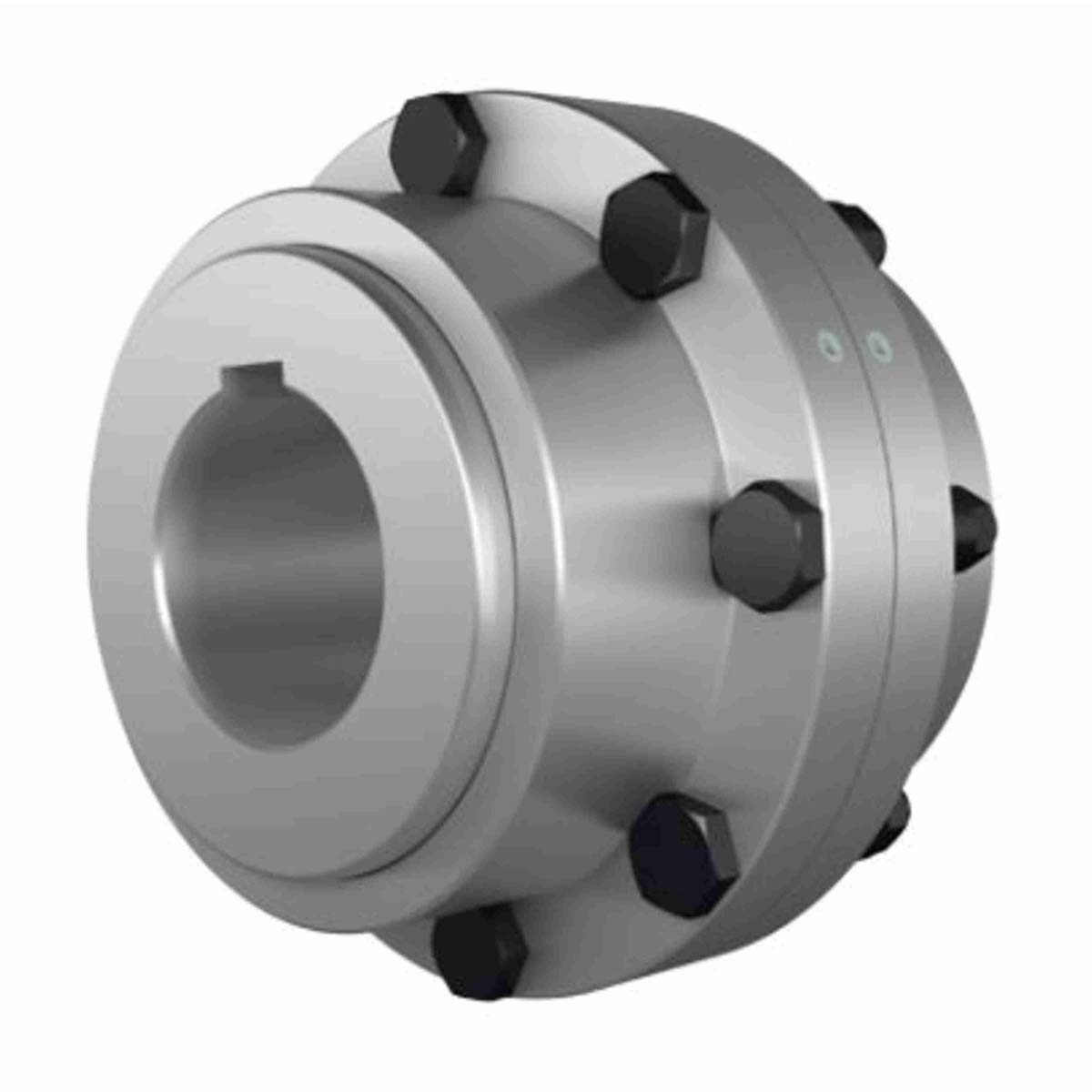
For demanding power-transmission systems, Gear Couplings are commonly considered because their toothed construction can support substantial torque transfer within a compact arrangement.
Anant Engineering positions its gear couplings for demanding industrial applications involving high loads, speed and torque transmission.
The correct coupling size should always be selected based on actual operating torque and application requirements.
How Can Torque Overload Be Prevented?
Before selecting a coupling, identify:
-
Motor power
-
Shaft RPM
-
Normal operating torque
-
Starting torque
-
Peak torque
-
Shock loading
-
Duty cycle
-
Service factor
This information helps prevent selecting a coupling that is too small for the application.
3. Can Poor Lubrication Cause Gear Coupling Failure?
Yes.
Lubricated coupling designs depend on the correct lubricant to reduce friction between moving surfaces.
A gear coupling failure can occur when lubrication becomes insufficient, contaminated or degraded.
Poor lubrication may lead to:
Loss of lubrication can be especially harmful in couplings that operate continuously or under high loads.
What Causes Coupling Lubrication Problems?
Common causes include:
How Can Lubrication Failure Be Prevented?
Follow the recommended maintenance interval for the coupling and operating environment.
During maintenance, check for:
The lubricant used should also be suitable for the coupling design, speed and operating temperature.
4. Can Incorrect Coupling Installation Cause Premature Failure?
Yes.
Even a correctly selected coupling can fail if it is installed incorrectly.
Common installation mistakes include:
-
Incorrect hub positioning
-
Improper bolt tightening
-
Incorrect key installation
-
Excessive interference fit
-
Poor shaft preparation
-
Incorrect spacing
-
Installing damaged components
-
Failing to align the shafts
Improper installation can create stresses that were not considered during coupling selection.
These stresses may eventually lead to vibration, loosening, wear or fatigue failure.
How Should Industrial Couplings Be Installed?
Installation should follow the manufacturer's specifications for:
-
Bore fit
-
Keyway dimensions
-
Bolt torque
-
Hub spacing
-
Shaft alignment
-
Lubrication
-
Operating clearances
The shafts and coupling components should also be inspected before assembly.
5. Why Does a Coupling Produce Excessive Vibration?
Coupling vibration may indicate a problem somewhere in the rotating system.
Possible causes include:
-
Shaft misalignment
-
Coupling imbalance
-
Worn flexible elements
-
Loose fasteners
-
Bent shafts
-
Bearing wear
-
Excessive clearance
-
Mechanical resonance
A coupling itself is not always the original source of vibration.
It may simply be transmitting vibration produced elsewhere in the machine.
Can Flexible Couplings Reduce Vibration?
Some flexible coupling designs can help absorb or isolate vibration and shock.
For example, Anant Engineering describes Pin Bush Couplings as suitable for applications involving torque transmission and misalignment, with flexible bushes providing controlled flexibility.
Jaw and tyre coupling designs can also provide flexibility through elastomeric elements.
However, persistent vibration should always be investigated because it may indicate a larger machinery problem.
6. Can Shock Loads Damage Industrial Couplings?
Yes.
Shock loads occur when torque changes rapidly rather than gradually.
This may happen in equipment such as:
Repeated shock loading can fatigue coupling components over time.
Pins, bushes, teeth, hubs and flexible elements may all experience accelerated wear.
Which Couplings Can Handle Shock Loads?
The best option depends on torque, speed and machine design.
Flexible couplings such as pin bush or elastomer-based designs may help reduce the amount of shock transferred between the driving and driven machinery.
Anant Engineering's pin bush coupling range is specifically described for applications involving torque transmission and varying misalignment requirements.
For heavier power-transmission systems, gear couplings may be more appropriate when high torque capacity is required.
7. What Happens When Coupling Maintenance Is Ignored?
Industrial couplings should not be treated as install-and-forget components.
Over time, normal operation can cause:
-
Wear
-
Fastener loosening
-
Lubricant deterioration
-
Flexible-element damage
-
Tooth wear
-
Seal degradation
-
Corrosion
-
Alignment changes
Without periodic inspection, small problems may remain unnoticed until the coupling fails.
How Often Should an Industrial Coupling Be Inspected?
Inspection frequency depends on:
Machines operating continuously or under harsh conditions may require more frequent checks than lightly loaded equipment.
What Causes Chain Coupling Failure?
A Chain Coupling typically uses two sprocket-style hubs connected by roller chain.
Anant Engineering's chain coupling range is designed for industrial torque transmission and is offered for applications requiring durability and limited misalignment accommodation.
Common chain coupling problems may include:
Regular inspection of the chain and sprocket teeth can help identify wear before the coupling becomes unreliable.
What Causes Gear Coupling Teeth to Wear?
Gear coupling teeth are exposed to repeated contact while transferring torque.
Abnormal wear can occur due to:
-
Insufficient lubrication
-
Excessive misalignment
-
Contaminated lubricant
-
High operating loads
-
Incorrect assembly
-
Surface corrosion
Uneven tooth wear may also indicate that the coupling is operating beyond its intended alignment conditions.
Early inspection is important because continued wear can increase clearance and reduce coupling reliability.
Can the Wrong Coupling Type Cause Machinery Problems?
Yes.
Different coupling designs solve different engineering problems.
For example:
Gear Couplings
Suitable where high torque transmission is an important requirement.
Pin Bush Couplings
Useful where limited flexibility, shock absorption and vibration control are required.
Jaw Couplings
Often selected for general-purpose machinery where elastomeric flexibility and vibration damping are useful.
Tyre Couplings
Can provide relatively high flexibility and vibration absorption.
Chain Couplings
Provide a compact mechanical connection for torque transmission in many general industrial systems.
Selecting a coupling because it simply fits the shaft dimensions may result in poor performance.
The complete operating conditions should determine which coupling is selected.
How Can You Prevent Industrial Coupling Failure?
A basic preventive approach can significantly improve coupling reliability.
1. Select the Correct Coupling
Match the coupling to:
-
Torque
-
Speed
-
Shaft diameter
-
Misalignment
-
Shock load
-
Operating environment
2. Align Shafts Correctly
Do not rely entirely on the coupling to compensate for poor machinery alignment.
3. Inspect the Coupling Regularly
Look for wear, cracks, damaged inserts, loose bolts and unusual movement.
4. Maintain Correct Lubrication
For coupling designs requiring lubrication, maintain the correct lubricant quantity and condition.
5. Monitor Machinery Vibration
Increasing vibration can indicate misalignment, wear or bearing problems.
6. Replace Worn Components Early
Bushes, flexible elements, chains and other replaceable parts should not remain in service after excessive wear develops.
7. Investigate Repeated Failure
If the same coupling repeatedly fails, replacing it alone may not solve the problem.
The root cause may be:
Should a Failed Coupling Simply Be Replaced?
Not always.
If a coupling has reached the end of its normal service life, replacement may be sufficient.
However, premature or repeated failure should be investigated.
Before installing another coupling, ask:
-
Was the coupling correctly sized?
-
Were the shafts properly aligned?
-
Did the machine experience overload?
-
Was lubrication adequate?
-
Are the bearings in good condition?
-
Is excessive vibration present?
-
Is the coupling type suitable for the application?
Replacing a coupling without correcting the root cause may result in another failure.
When Should an Industrial Coupling Be Replaced?
A coupling should be considered for replacement when inspection identifies damage beyond the acceptable service limit.
Possible indicators include:
Replacement decisions should follow the applicable manufacturer's inspection limits and machinery requirements.
Choosing the Right Coupling Can Reduce Failure Risk
Many industrial coupling failures are related to selection, alignment, installation and maintenance rather than the coupling alone.
Understanding the machine's torque, speed, shaft dimensions, shock loads and environmental conditions allows a more appropriate coupling to be selected from the beginning.
For industrial power-transmission applications, Anant Engineering offers multiple coupling designs including Gear Couplings, Chain Couplings and Pin Bush Couplings.
Correct coupling selection, proper alignment and preventive maintenance can help reduce unplanned downtime and extend the service life of the entire drive system.

 Industrial Couplings
 Industrial Gears
 Sprocket
 Industrial Roller Chain
 Pulleys
 Plummer Block
 Gearbox