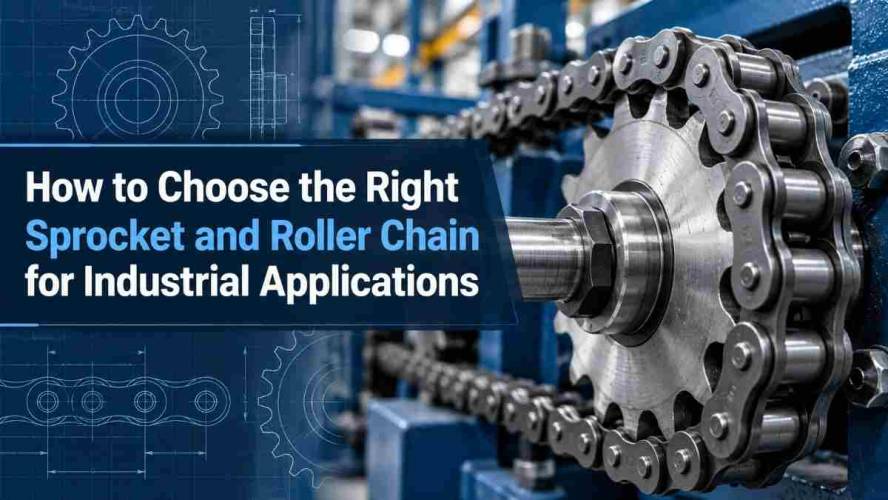
Sprockets and roller chains are widely used in industrial machinery to transfer power between rotating shafts.
They may look like relatively simple components, but incorrect sizing or mismatched chain and sprocket combinations can lead to excessive wear, noise, vibration and premature drive failure.
Understanding how to choose a sprocket and roller chain is therefore important when designing new machinery or replacing existing transmission components.
The correct selection depends on several factors, including chain pitch, number of sprocket teeth, operating speed, torque, load conditions and working environment.
This guide explains the main factors engineers and maintenance teams should consider before selecting an industrial chain and sprocket system.
What Is a Chain and Sprocket System?
A chain and sprocket drive uses a roller chain running over toothed sprockets to transmit rotational power.
One sprocket is typically connected to the driving shaft while the other is connected to the driven shaft.
As the driving sprocket rotates, its teeth engage the chain rollers and pull the chain around the system.
This transfers motion and torque to the driven sprocket.
Chain and sprocket systems are commonly used in:
-
Conveyors
-
Packaging machinery
-
Agricultural equipment
-
Material-handling systems
-
Industrial production lines
-
Processing machinery
-
Mining equipment
-
Textile machinery
-
General power-transmission systems
The performance of the drive depends on the chain and sprocket working together correctly.
Why Is Correct Sprocket and Roller Chain Selection Important?
Poor component selection can create uneven loading in the drive system.
That may result in:
-
Rapid chain elongation
-
Sprocket tooth wear
-
Increased vibration
-
Excessive noise
-
Reduced power-transmission efficiency
-
Frequent chain adjustment
-
Premature component failure
-
Unplanned machine downtime
Anant Engineering's industrial sprocket material notes that accurate tooth geometry and pitch matching help maintain proper chain engagement and reduce uneven loading.
For this reason, industrial sprocket selection should not be based on shaft diameter alone.
The entire operating system needs to be considered.
What Information Do You Need Before Selecting a Chain and Sprocket?
Before selecting components, collect the main operating data.
Important factors include:
These details help determine the required chain size, sprocket dimensions and tooth count.
What Is Roller Chain Pitch?
Chain pitch is the distance between the centers of two consecutive chain pins.
It is one of the most important dimensions in a roller chain system.
The pitch of the roller chain must match the pitch of the sprocket teeth.
If the chain and sprocket pitch do not match correctly, proper engagement is impossible.
Industrial chains are available in different pitch sizes depending on load and application.
Anant Engineering's roller-chain product pages list simplex, duplex and triplex transmission chains with pitch ranges extending from 3/8 inch to 3 inches.
How Do You Choose the Correct Roller Chain Size?
Roller chain selection depends on more than pitch.
The chain must handle the load transmitted by the drive.
Important considerations include:
Power Requirement
Determine how much power needs to be transmitted.
Higher-power applications generally require a stronger chain or multiple chain strands.
Operating Speed
Check the RPM of the smaller sprocket.
Very high chain speeds may require different design considerations than slow-moving industrial drives.
Torque
Higher torque places greater tension on the chain.
Duty Cycle
A machine running continuously for long periods may require a more robust chain than equipment operating occasionally.
Shock Loading
Machines with frequent starts, stops or sudden load changes may require additional strength.
Anant Engineering's roller-chain guidance specifically notes that chain size selection depends on transmitted load, operating speed, duty cycle and service factor.
What Is the Difference Between Simplex, Duplex and Triplex Roller Chains?
Roller chains can use one or multiple rows of links.
Simplex Roller Chain
A simplex chain has one row of rollers.
It is generally used where the transmitted load can be handled by a single chain strand.
Duplex Roller Chain
A duplex chain has two parallel rows.
This increases load-carrying capability compared with a simplex design.
Triplex Roller Chain
A triplex chain uses three parallel rows.
It may be selected for heavier power-transmission requirements.
Anant Engineering offers simplex, duplex and triplex transmission roller-chain configurations.
The correct choice should be based on the actual torque, speed and load of the machine.
How Do You Choose the Correct Sprocket?
An industrial sprocket must match the roller chain and operating requirements.
Important selection factors include:
-
Chain pitch
-
Number of teeth
-
Bore size
-
Shaft diameter
-
Hub design
-
Material
-
Speed
-
Torque
-
Application type
The sprocket's tooth profile must also match the geometry of the roller chain.
Poor tooth geometry can create uneven engagement and increase wear on both components.
How Many Teeth Should an Industrial Sprocket Have?
The number of teeth affects speed, torque and chain wear.
A smaller sprocket generally rotates faster and creates a smaller overall drive.
However, using too few teeth can increase chain articulation as each roller enters and leaves the sprocket.
This can contribute to increased wear and vibration.
A larger sprocket generally provides smoother chain engagement.
The correct number of teeth depends on:
-
Required speed ratio
-
Available space
-
Chain pitch
-
Motor RPM
-
Driven shaft speed
-
Torque requirements
Anant Engineering's industrial sprocket range includes simplex sprockets with approximately 8 to 125 teeth, duplex options up to around 120 teeth and triplex options across a broad industrial range.
How Is the Sprocket Speed Ratio Calculated?
The speed ratio is determined by comparing the number of teeth on the driving and driven sprockets.
A simple relationship is:
Driven Speed = Driver Speed × Driver Teeth ÷ Driven Teeth
For example:
If the driver sprocket has 20 teeth and the driven sprocket has 40 teeth, the driven shaft will rotate at approximately half the speed of the driver.
This relationship is useful when selecting sprocket sizes for conveyors, processing equipment and general industrial drives.
How Does Sprocket Diameter Affect the Drive?
Increasing the number of sprocket teeth usually increases sprocket diameter.
A larger sprocket may provide:
-
Smoother chain engagement
-
Reduced articulation angle
-
Lower wear
-
Larger installation-space requirements
A smaller sprocket can make the system more compact but may increase chain movement around each tooth.
The available machine space and desired service life therefore need to be balanced.
What Material Is Best for Industrial Sprockets?
Sprocket material should be selected based on torque, wear, operating environment and expected service life.
Common materials can include:
-
Mild steel
-
Cast iron
-
Alloy steel
-
Forged steel
-
Cast steel
-
Stainless steel
Anant Engineering lists industrial sprocket materials including M.S., C.I., EN grades, forged steel, cast steel and stainless steel across its product range.
Heavy-duty applications may benefit from stronger or heat-treated materials where additional wear resistance is required.
How Does Torque Affect Sprocket Selection?
Torque creates force on the sprocket teeth and tension in the roller chain.
Higher torque can increase:
-
Chain tension
-
Tooth loading
-
Shaft loading
-
Bearing loading
A sprocket should therefore have sufficient material strength, hub dimensions and tooth geometry for the application.
An undersized sprocket or chain may experience excessive wear or failure.
How Does RPM Affect Roller Chain Selection?
Operating speed affects how frequently the chain articulates around the sprockets.
At higher speeds:
-
Chain engagement happens more frequently
-
Lubrication becomes more important
-
Dynamic forces increase
-
Vibration may become more noticeable
-
Wear can accelerate if alignment is poor
Higher-speed systems therefore require careful attention to chain size, sprocket tooth count, lubrication and alignment.
Which Chain and Sprocket System Is Best for Conveyors?
Conveyor systems commonly use industrial chain drives because they provide positive mechanical power transmission.
Selection depends on:
-
Conveyor length
-
Material load
-
Motor power
-
Conveyor speed
-
Start-stop frequency
-
Environmental conditions
Heavy conveyors may require duplex or triplex chains, while lighter conveyors may operate effectively with simplex chains.
The sprocket should also be sized to provide the required conveyor speed and torque.
Anant Engineering manufactures industrial sprockets for conveyor and material-handling applications where torque transmission and consistent chain engagement are important.
Which Sprocket Is Best for Heavy-Duty Machinery?
Heavy-duty machinery may require sprockets with:
Applications such as mining, steel processing and bulk material handling often expose sprockets to heavy loads and abrasive environments.
In these conditions, durability and wear resistance become especially important.
What Causes Sprocket Teeth to Wear?
Sprocket teeth gradually wear as the chain repeatedly engages them.
Premature wear may result from:
-
Poor chain lubrication
-
Incorrect chain pitch
-
Chain elongation
-
Misalignment
-
Excessive torque
-
Contamination
-
Incorrect tension
-
Poor tooth geometry
As sprocket wear increases, the tooth profile can become hooked or uneven.
This reduces proper chain engagement and can accelerate chain wear.
What Causes Roller Chain Elongation?
Roller chains do not normally stretch because the metal itself becomes longer.
Most apparent chain elongation comes from wear between pins and bushes.
Common causes include:
Anant Engineering's roller-chain material identifies pin-and-bush wear as a major cause of chain elongation and notes that poor lubrication or excessive load can accelerate this problem.
Should You Replace the Chain and Sprocket Together?
In many cases, replacing both may provide better long-term performance.
A heavily worn sprocket can quickly damage a new roller chain.
Similarly, a severely elongated chain can accelerate wear on a new sprocket.
Inspect both components whenever either shows significant wear.
Check for:
-
Hooked sprocket teeth
-
Uneven tooth wear
-
Chain elongation
-
Damaged rollers
-
Stiff chain links
-
Excessive clearance
If both components are substantially worn, replacing them as a matched set may help restore correct engagement.
How Important Is Chain and Sprocket Alignment?
Alignment is extremely important.
The driving and driven sprockets should operate in the same plane.
Misalignment can cause:
-
Side loading
-
Uneven tooth wear
-
Chain-guide wear
-
Increased vibration
-
Chain derailment
-
Shorter chain life
Straightedges, laser alignment tools or appropriate measurement methods can be used to verify alignment during installation.
How Tight Should a Roller Chain Be?
A roller chain should generally not be installed excessively tight.
A chain that is too tight can increase loads on:
-
Bearings
-
Shafts
-
Sprocket teeth
-
Chain pins
A chain that is too loose may experience:
-
Excessive vibration
-
Chain jumping
-
Poor engagement
-
Impact loading
The correct amount of slack depends on the drive layout, center distance and manufacturer's installation recommendations.
Why Is Roller Chain Lubrication Important?
Lubrication reduces friction between the chain's moving components.
Correct lubrication can help reduce:
-
Pin wear
-
Bush wear
-
Roller wear
-
Heat generation
-
Noise
-
Corrosion
Lubricant should reach the internal pin-and-bush contact areas rather than simply coating the outside of the chain.
Operating speed, temperature and contamination levels should be considered when establishing lubrication intervals.
How Often Should Chain and Sprocket Systems Be Inspected?
Inspection frequency depends on operating conditions.
Systems exposed to high loads, dust or continuous operation may require more frequent inspection.
Maintenance teams should regularly check:
-
Chain elongation
-
Lubrication condition
-
Sprocket tooth wear
-
Chain tension
-
Alignment
-
Roller condition
-
Corrosion
-
Unusual noise
-
Vibration
Early detection of wear can prevent unexpected drive-system failures.
What Are Common Mistakes When Choosing a Sprocket and Roller Chain?
Several mistakes can shorten component life.
Choosing Only by Shaft Diameter
Shaft size does not determine chain capacity.
Torque and load also matter.
Ignoring Chain Pitch
The chain pitch must correctly match the sprocket.
Using Too Small a Sprocket
Very small sprockets can increase chain articulation and wear.
Ignoring Shock Loads
Sudden loads may require a stronger chain arrangement.
Ignoring Alignment
Even good-quality components can wear rapidly when shafts and sprockets are misaligned.
Ignoring the Operating Environment
Dust, moisture, heat and chemicals may affect material and lubrication requirements.
What Information Should You Give a Sprocket or Chain Manufacturer?
When requesting a quotation or technical recommendation, provide as much operating data as possible.
Useful information includes:
-
Chain pitch
-
Required sprocket teeth
-
Shaft diameter
-
Bore dimensions
-
Keyway size
-
Motor power
-
Operating RPM
-
Required speed ratio
-
Torque
-
Number of chain strands
-
Application type
-
Material preference
-
Operating environment
For replacement components, drawings or samples can also help confirm dimensional requirements.
How Do You Choose the Right Sprocket and Roller Chain?
A practical selection process is:
-
Identify the machine application.
-
Determine motor power.
-
Record driver and driven RPM.
-
Determine the required speed ratio.
-
Calculate the operating load and torque.
-
Select an appropriate roller-chain pitch and capacity.
-
Decide whether simplex, duplex or triplex chain is required.
-
Select compatible sprocket tooth counts.
-
Check shaft and bore dimensions.
-
Consider materials and environmental conditions.
-
Verify alignment and lubrication requirements.
-
Confirm the selected components against manufacturer specifications.
The sprocket and chain should always be selected as part of the same power-transmission system.
Choosing a Reliable Industrial Chain and Sprocket System
Choosing the right sprocket and roller chain requires balancing load, speed, torque, pitch, tooth count and operating conditions.
A correctly matched system can provide smooth power transmission, stable chain engagement and reliable machinery operation.
Anant Engineering supplies industrial sprockets and roller-chain components for manufacturing, conveyors, material handling and other industrial applications.
Its industrial sprocket range includes simplex, duplex and triplex configurations across broad tooth-count and pitch ranges, while its roller-chain range includes simplex, duplex and triplex transmission chains for different power requirements.
Evaluating the complete drive system before purchasing components can help reduce premature chain wear, sprocket damage and unnecessary maintenance.

 Industrial Couplings
 Industrial Gears
 Sprocket
 Industrial Roller Chain
 Pulleys
 Plummer Block
 Gearbox