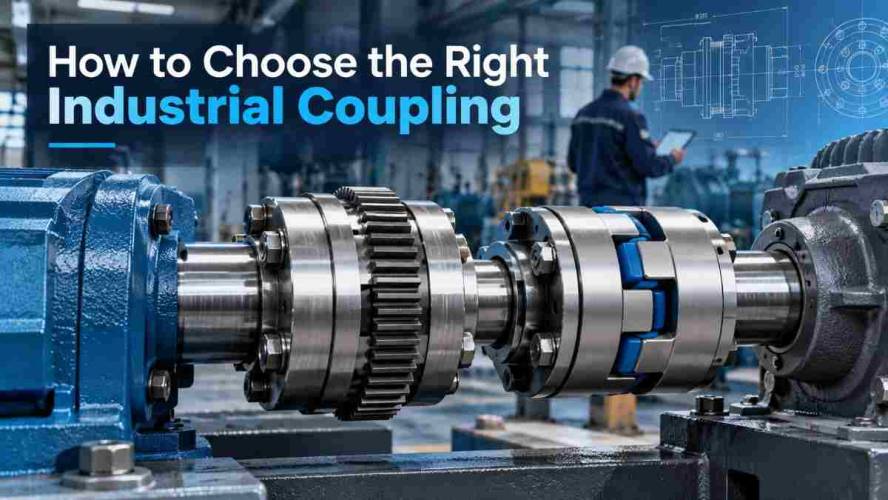
Industrial machinery depends on efficient power transmission between rotating components. While motors, gearboxes, pumps and driven equipment receive most of the attention, the component connecting their shafts is equally important.
An industrial coupling connects two rotating shafts and allows torque to transfer from one component to another. Choosing the wrong coupling can contribute to excessive vibration, premature component wear, alignment problems and unnecessary maintenance.
However, there is no single coupling suitable for every machine. Different designs are intended for different torque levels, speeds, operating conditions and degrees of misalignment.
This guide explains how to choose an industrial coupling and which factors engineers and equipment owners should consider before selecting one.
What Is an Industrial Coupling?
An industrial coupling is a mechanical component used to connect two shafts so rotational power and torque can pass between them.
Depending on its design, a coupling may also help accommodate small amounts of shaft misalignment, absorb vibration or shock loads, and protect connected machinery from excessive mechanical stress.
Industrial couplings are commonly found in equipment such as:
Because operating conditions can vary significantly between these machines, industrial coupling selection should be based on the requirements of the complete drive system.
Why Is Choosing the Right Coupling Important?
A coupling may appear to be a relatively small part of a machine, but it sits directly in the power-transmission path.
An incorrectly selected coupling may experience loads or operating conditions it was not designed to handle.
The right coupling can help provide:
-
Reliable torque transmission
-
Better accommodation of permissible shaft misalignment
-
Reduced vibration and shock transfer
-
Longer component life
-
Consistent machinery operation
-
Easier maintenance
-
Reduced stress on connected shafts and bearings
Therefore, coupling selection should not be based only on shaft diameter or price.
Torque, speed, load characteristics, alignment and the surrounding operating environment should all be considered.
What Information Do You Need Before Selecting an Industrial Coupling?
Before choosing a coupling for machinery, collect the basic operating information for both the driving and driven equipment.
Important specifications include:
1. Required Torque
Determine how much torque the coupling will need to transmit during normal operation.
The coupling should be selected for the actual operating requirements rather than simply matching the physical shaft dimensions.
Applications with frequent starts, stops or sudden load changes may also experience torque peaks that need to be considered.
2. Operating Speed
Check the rotational speed of the shaft in RPM.
Different coupling designs and sizes have different speed capabilities. A coupling suitable for a slow conveyor may not necessarily be appropriate for high-speed rotating equipment.
3. Shaft Diameter
Measure the shaft diameter of both connected components.
The selected coupling must accommodate the required bore sizes while maintaining sufficient strength for the transmitted torque.
4. Misalignment
Perfect shaft alignment is difficult to maintain in many industrial installations.
Misalignment may occur in different forms, including:
The allowable amount depends on the coupling design.
5. Operating Environment
The surrounding environment can also affect industrial coupling selection.
Consider factors such as:
Once these factors are known, it becomes much easier to compare different coupling designs.
How Does Torque Affect Coupling Selection?
Torque capacity is one of the most important factors when choosing a coupling.
If a coupling is undersized for the application, repeated overloads may accelerate wear or cause premature failure.
High-torque industrial applications often require strong metallic coupling designs capable of transmitting substantial power between shafts.
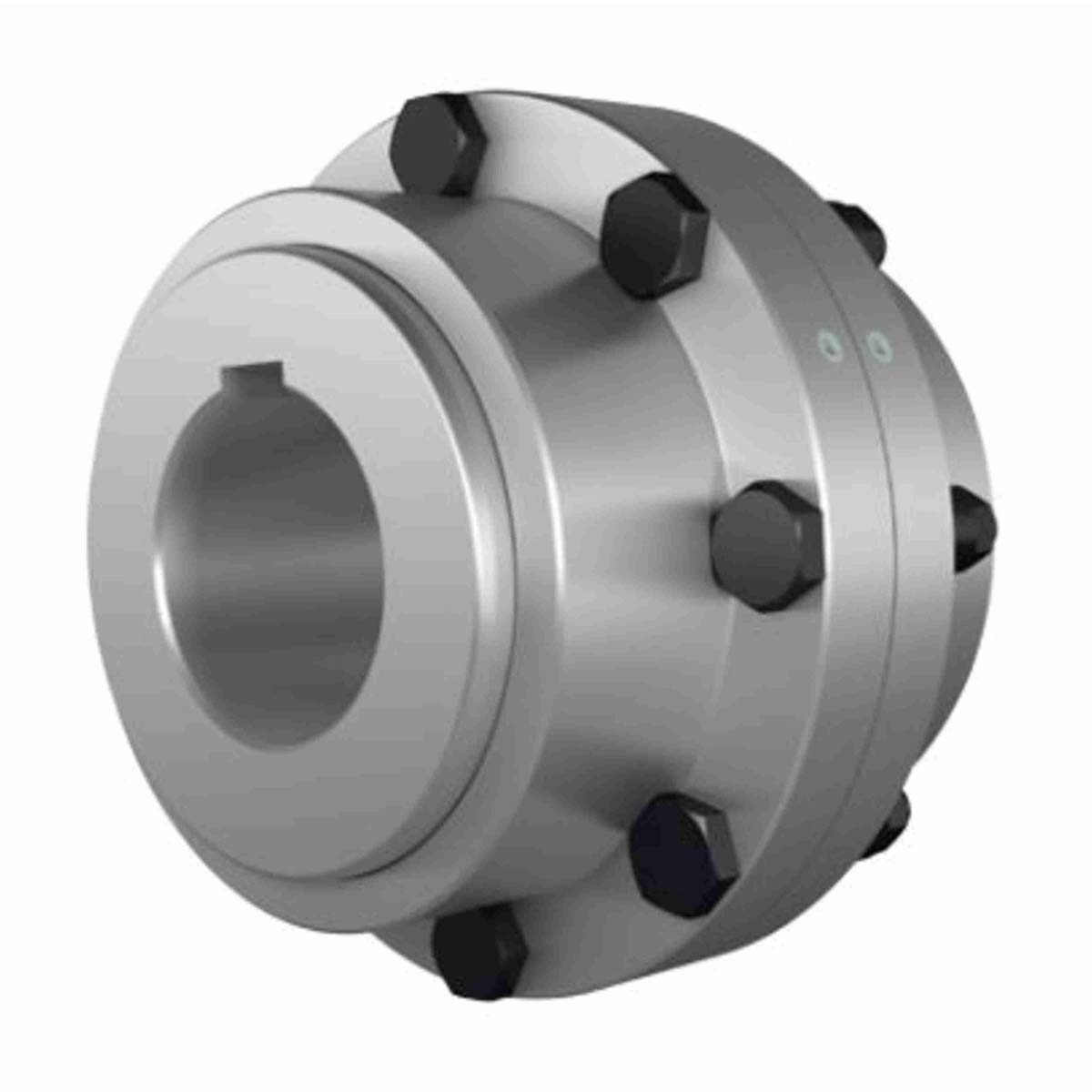
A gear coupling, for example, uses toothed engagement to transmit torque and is commonly considered for demanding power-transmission applications.
Gear couplings can be useful in equipment where high torque capacity, compact construction and accommodation of limited misalignment are required.
For the available product range, see Anant Engineering's Gear Coupling page.
Which Coupling Is Best for Shaft Misalignment?
The answer depends on the type and amount of misalignment.
Flexible coupling designs can accommodate limited misalignment while transmitting torque between shafts. However, every coupling has defined operating limits.
A coupling should never be used as a substitute for proper machine alignment.
If significant vibration, bearing wear or shaft movement is occurring, the underlying alignment problem should also be investigated.
Some commonly used flexible designs include jaw, tyre, pin bush, chain and disc couplings.
The appropriate option depends on the combination of torque, speed, shaft size and operating conditions.
When Should You Use a Gear Coupling?
A gear coupling can be considered where relatively high torque needs to be transmitted through a compact coupling arrangement.
Gear couplings typically use externally and internally toothed components to transfer torque between connected shafts.
They are commonly considered in heavier industrial drive systems where mechanical strength is a major requirement.
Potential applications can include:
Selection should still be based on the required torque, bore size, speed and permissible misalignment for the specific coupling.
When Is a Jaw Coupling a Better Choice?
A jaw coupling uses hubs connected through an elastomeric element or spider.
The flexible element can help reduce vibration and cushion shock between the driving and driven equipment.
Jaw couplings may be suitable for many light- to medium-duty power-transmission applications where flexibility and relatively simple maintenance are desirable.
Typical applications may include:
-
Pumps
-
Compressors
-
Fans
-
Small industrial drives
-
General machinery
When comparing a gear coupling vs jaw coupling, the decision should therefore not be based simply on which design is stronger.
The actual machine load, torque, speed and vibration characteristics should determine the selection.
What Is a Pin Bush Coupling Used For?
A pin bush coupling uses pins with flexible bushes to transmit torque.
The bushes introduce flexibility into the connection and can help absorb shock and vibration between connected shafts.
This design can be useful in applications where machinery experiences load changes, vibration or frequent starts and stops.
Pin bush couplings may be considered for:
Correct sizing remains important because the coupling must handle both the required torque and the operating conditions of the machine.
When Should You Consider an Industrial Tyre Coupling?
An industrial tyre coupling uses a flexible tyre-shaped element between its hubs.
The flexible element can provide vibration damping and accommodate shaft movement within the coupling's design limits.
Tyre couplings may be particularly useful in machines exposed to vibration, shock loading or varying operating conditions.
Applications can include:
Because tyre couplings provide a flexible connection, they may also reduce the amount of vibration transferred between connected equipment.
What Is a Chain Coupling?
A chain coupling generally uses two sprocket-type hubs connected by a roller chain.
The arrangement creates a compact mechanical connection capable of transmitting torque between shafts.
Chain couplings may be considered for industrial applications where a straightforward, durable coupling system is needed and maintenance access is available.
Potential applications include:
Maintenance and lubrication requirements should be checked when evaluating a chain coupling for continuous operation.
When Is a Nylon Sleeve Gear Coupling Useful?
A nylon sleeve gear coupling uses a nylon sleeve to connect geared hubs.
This design provides a compact flexible connection and can be useful for relatively light industrial applications requiring smooth torque transmission.
Because the sleeve itself provides flexibility, this coupling type can be attractive where compact dimensions and relatively simple operation are priorities.
Suitable applications depend on the selected size, bore, speed and torque rating.
When Should You Consider a Disc Coupling?
A disc coupling uses flexible metallic discs to transmit torque between hubs.
Disc couplings are often considered where precise torque transmission and controlled flexibility are important.
Since torque is transferred through metallic elements rather than an elastomeric spider or tyre, disc couplings can suit applications where operating characteristics favor a metallic flexible connection.
The exact selection should be based on torque, speed, shaft dimensions, alignment requirements and the coupling manufacturer's specifications.
Which Coupling Is Best for Pumps?
There is no universal best coupling for every pump.
The correct choice depends on:
-
Motor power
-
Pump speed
-
Shaft diameter
-
Starting torque
-
Alignment
-
Vibration
-
Maintenance requirements
-
Operating environment
Jaw couplings may work well for many general pump installations, while other applications may require spacer, disc, pin bush or other flexible coupling designs.
For installations where pump maintenance requires separation without significantly repositioning connected equipment, a spacer-type coupling may also be considered.
Which Coupling Is Best for Conveyors?
Conveyor drives can experience changing loads, frequent starts and continuous operation.
Depending on the size and design of the conveyor, suitable options may include:
-
Gear couplings
-
Pin bush couplings
-
Tyre couplings
-
Chain couplings
-
Jaw couplings
Heavy-duty conveyor systems may prioritize torque capacity and resistance to shock loading, whereas smaller conveyor systems may place more emphasis on simplicity and vibration absorption.
Therefore, conveyor coupling selection should always begin with actual operating torque and service conditions.
How Do Shock Loads and Vibration Affect Coupling Selection?
Machines do not always operate under perfectly steady loads.
Crushers, conveyors, mixers and other industrial equipment may experience sudden changes in torque during operation.
Repeated shock loading can place additional stress on shafts, bearings and coupling components.
Flexible coupling designs can help absorb or isolate some of these dynamic forces.
For vibration-prone equipment, jaw, pin bush or tyre couplings may be worth evaluating depending on the required torque and operating speed.
However, persistent or unusually high vibration should be investigated rather than simply compensated for with a different coupling.
Does Coupling Maintenance Matter?
Yes.
Even a correctly selected coupling can perform poorly if installation and maintenance are neglected.
Maintenance requirements differ by design.
Some couplings may require:
Following the manufacturer's installation and maintenance instructions can help prevent premature coupling wear.
What Are Common Mistakes When Selecting an Industrial Coupling?
Several mistakes can reduce coupling life or machinery reliability.
Selecting Only by Shaft Diameter
Two machines with identical shaft diameters may transmit very different torque levels.
Bore size alone is therefore not enough for coupling selection.
Ignoring Peak Loads
Starting torque and sudden load changes may be significantly higher than normal operating torque.
Ignoring Misalignment
Different couplings tolerate different amounts and types of misalignment.
Choosing an Oversized Coupling Without Considering the Complete System
Bigger does not automatically mean better.
Weight, rotational inertia, shaft dimensions, speed and installation space also matter.
Ignoring Maintenance Requirements
A technically suitable coupling may still be inconvenient if it requires maintenance that is difficult to perform in the installation.
How Do You Choose Between Different Industrial Couplings?
A practical selection process can be summarized as follows:
-
Identify the driving and driven equipment.
-
Determine motor power and operating speed.
-
Calculate or confirm required torque.
-
Consider starting and shock loads.
-
Measure both shaft diameters.
-
Determine expected shaft misalignment.
-
Check available installation space.
-
Evaluate temperature and environmental conditions.
-
Consider maintenance accessibility.
-
Compare suitable coupling designs and manufacturer specifications.
Instead of beginning with a particular coupling type, begin with the machinery requirements.
The operating data should determine the coupling—not the other way around.
What Information Should You Give a Coupling Manufacturer?
When requesting a coupling recommendation or quotation, providing complete technical information can make selection easier and more accurate.
Where possible, provide:
-
Application or machine type
-
Motor power
-
Operating RPM
-
Required torque
-
Driver shaft diameter
-
Driven shaft diameter
-
Keyway dimensions
-
Distance between shaft ends
-
Expected misalignment
-
Operating temperature
-
Working environment
-
Existing coupling details, if replacing one
-
Any unusual shock or cyclic loading
This information allows the coupling manufacturer to narrow down the suitable designs and sizes.
Choosing an Industrial Coupling for Reliable Power Transmission
Choosing the right industrial coupling requires more than finding a component that fits between two shafts.
Torque, speed, shaft dimensions, misalignment, shock loading, vibration and operating conditions all affect the decision.
Gear couplings may suit demanding high-torque applications, while jaw, pin bush and tyre couplings provide different levels of flexibility and vibration absorption. Chain, nylon sleeve and disc couplings can address other power-transmission requirements.
Anant Engineering offers a broad range of industrial couplings for different machinery and power-transmission applications. Reviewing the complete operating requirements before selecting a coupling can help identify a solution suited to the machine rather than simply selecting by size.
For application-specific requirements, businesses can share their torque, shaft, speed and operating details with Anant Engineering to identify an appropriate coupling option.

 Industrial Couplings
 Industrial Gears
 Sprocket
 Industrial Roller Chain
 Pulleys
 Plummer Block
 Gearbox