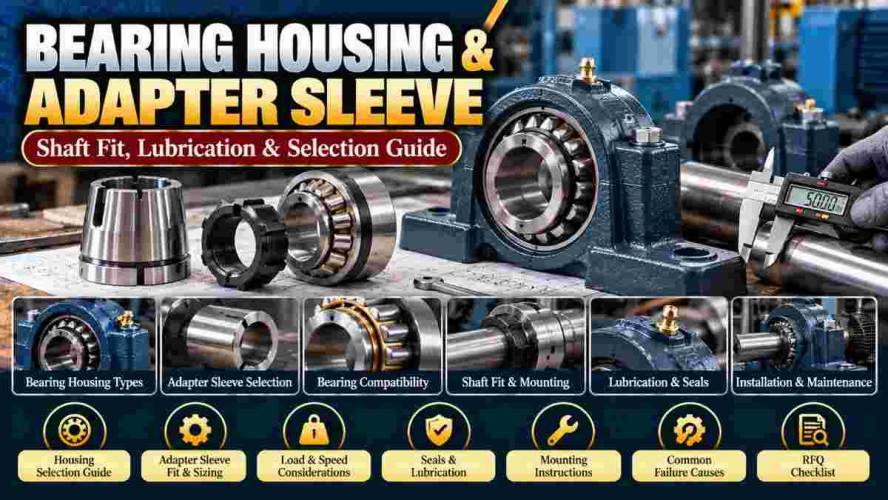
Are you replacing a bearing housing or installing a new rotating shaft assembly? Incorrect housing dimensions, bearing fits, or adapter sleeves can cause vibration, overheating, and premature component failure.
Industrial bearing housing selection depends on shaft diameter, bearing type, housing dimensions, operating loads, seals, lubrication, mounting requirements, and environmental conditions.
An adapter sleeve may also be required when mounting a compatible tapered-bore bearing onto a cylindrical shaft.
Anant Engineering offers bearing housings and adapter sleeves for industrial machinery applications.
What Is an Industrial Bearing Housing?
A bearing housing is a mechanical component that supports a bearing and provides its connection to the surrounding machine structure.
Bearing housings are commonly used in:
The housing must accommodate the specified bearing, operating loads, shaft arrangement, and mounting conditions.
Explore Bearing Housings for available products.
What Is a Plummer Block Bearing Housing?
A plummer block is a mounted bearing housing commonly used to support horizontal rotating shafts in industrial machinery.
Many plummer block designs have split housings that facilitate inspection and maintenance.
Typical components include:
The housing configuration should match the bearing and shaft design.
What Is a Bearing Adapter Sleeve?
An adapter sleeve is a tapered mounting component used to secure a compatible tapered-bore bearing onto a cylindrical shaft seat.
An adapter sleeve assembly typically includes a tapered sleeve and an appropriate locking arrangement.
It can simplify mounting on straight or stepped shafts, depending on the bearing arrangement.
Explore Adapter Sleeves for product details.
How Do You Choose the Correct Bearing Housing Size?
Select housing size using the bearing designation, shaft diameter, required locating arrangement, and manufacturer's dimensional specifications.
Check:
Never assume housings with similar external dimensions are interchangeable.
Why Is Shaft Diameter Important for Adapter Sleeve Selection?
Shaft diameter determines the sleeve bore size and affects the suitability of the bearing mounting arrangement.
Before ordering, confirm:
Use the bearing manufacturer's approved dimensional specifications.
Which Bearing Types Are Used With Industrial Housings?
Bearing housings may accommodate different bearing types depending on load direction, speed, shaft arrangement, and housing design.
Common examples include:
-
Spherical roller bearings.
-
Self-aligning ball bearings.
-
Other compatible bearing arrangements.
Spherical roller bearings are frequently selected for applications involving substantial radial loads and certain alignment requirements.
The bearing type must be compatible with the housing.
How Do Operating Loads Affect Bearing Housing Selection?
Operating loads influence bearing capacity, housing strength, shaft support, and mounting requirements.
Important considerations include:
-
Radial load.
-
Axial load.
-
Rotational speed.
-
Shock loading.
-
Duty cycle.
-
Shaft deflection.
-
Operating temperature.
A housing should not be selected solely by shaft diameter without evaluating the complete bearing arrangement.
Which Materials Are Suitable for Bearing Housings?
Bearing housing materials should be selected according to structural loading, environmental exposure, vibration, and application requirements.
Common materials include:
Material selection should consider expected loads, mounting conditions, and operating environment.
Why Are Bearing Housing Seals Important?
Seals help retain lubricant and reduce the entry of dust, moisture, and other contaminants.
Common sealing arrangements may include:
Select seals according to speed, contamination, temperature, and housing compatibility.
How Do You Choose the Correct Bearing Lubrication?
Bearing lubrication should be selected according to operating speed, load, temperature, bearing type, and housing design.
Industrial bearing housings may use grease or oil lubrication.
Important factors include:
-
Lubricant compatibility.
-
Operating temperature.
-
Relubrication intervals.
-
Contamination.
-
Seal design.
-
Maintenance access.
Follow the bearing manufacturer's lubrication recommendations.
How Should Adapter Sleeves Be Installed?
Adapter sleeves must be installed using the bearing manufacturer's specified mounting procedure and required interference fit.
Depending on the bearing, installation may involve measuring radial internal clearance reduction or axial drive-up.
Important precautions include:
-
Clean the shaft.
-
Check dimensions.
-
Inspect the sleeve.
-
Position the components correctly.
-
Follow the approved tightening procedure.
-
Verify bearing clearance.
-
Secure the locking arrangement.
Incorrect installation can damage the bearing or reduce its service life.
What Causes Bearing Housing Failure?
Bearing housing problems can develop from incorrect mounting, contamination, inadequate lubrication, excessive loads, and mechanical damage.
Warning signs include:
-
Unusual vibration.
-
Excessive temperature.
-
Lubricant leakage.
-
Abnormal noise.
-
Loose mounting bolts.
-
Corrosion.
-
Housing cracks.
Investigate the complete shaft and bearing assembly when recurring problems occur.
What Should You Check Before Ordering Replacement Components?
Replacement bearing housings and adapter sleeves must match the existing bearing arrangement and approved equipment specifications.
Verify:
Original drawings or component markings can help identify the correct replacement.
What Factors Affect Bearing Housing and Adapter Sleeve Prices?
Prices depend on dimensions, material, bearing compatibility, design complexity, machining requirements, and quantity.
Important cost factors include:
Compare quotations using identical technical requirements.
What Should You Include in a Bearing Housing RFQ?
A complete quotation request should specify the bearing arrangement, shaft dimensions, housing requirements, and operating conditions.
Include:
-
Bearing designation.
-
Shaft diameter.
-
Housing type and model.
-
Adapter sleeve requirement.
-
Operating load and speed.
-
Mounting dimensions.
-
Seal type.
-
Lubrication requirements.
-
Material preference.
-
Technical drawing or sample.
-
Quantity.
-
Delivery location.
This information helps suppliers evaluate compatibility.
Why Should Buyers Consider Anant Engineering?
Anant Engineering offers bearing housings and adapter sleeves among its industrial mechanical components.
Its website includes dedicated product information for both categories.
Explore Bearing Housings and Adapter Sleeves.
Confirm current dimensions, bearing compatibility, material specifications, and availability before ordering.
What Are the Most Frequently Asked Questions About Bearing Housings?
Common questions concern shaft compatibility, adapter sleeves, lubrication, maintenance, and replacements.
Are Bearing Housings and Plummer Blocks the Same?
A plummer block is a type of bearing housing used to support rotating shafts.
Can Adapter Sleeves Be Used With Every Bearing?
No. Adapter sleeves are intended for compatible tapered-bore bearing arrangements.
Do Bearing Housings Require Lubrication?
Most rolling-bearing arrangements require appropriate lubrication, but the method depends on the bearing and housing design.
Can Bearing Housings Be Customized?
Custom configurations may be possible depending on the manufacturer's capabilities and engineering requirements.
What Causes Bearing Housing Overheating?
Possible causes include excessive loads, incorrect lubrication, bearing damage, improper mounting, or unsuitable operating conditions.
How Can You Request Bearing Housings and Adapter Sleeves From Anant Engineering?
You can request a quotation by sharing your bearing designation, shaft diameter, housing dimensions, adapter sleeve requirements, and quantity.
For replacement applications, provide component markings, technical drawings, or samples.
Explore Bearing Housings, Adapter Sleeves, or visit Anant Engineering to discuss your requirements.
Technical Note: Final component selection and installation should follow the approved equipment design, bearing manufacturer's instructions, and application-specific load and mounting requirements.

 Industrial Couplings
 Industrial Gears
 Sprocket
 Industrial Roller Chain
 Pulleys
 Plummer Block
 Gearbox