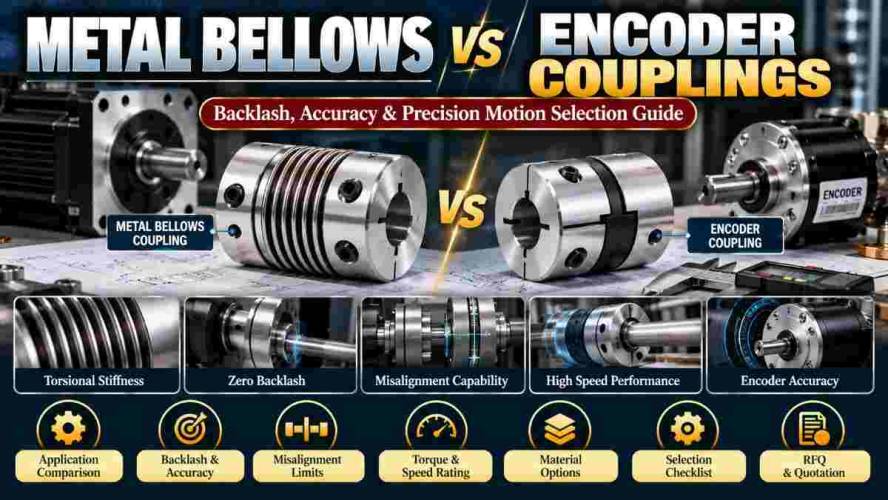
Are you selecting a shaft coupling for an encoder, servo motor, CNC machine, or precision automation system? Choosing an unsuitable coupling can cause positioning errors, vibration, premature bearing wear, and unreliable motion control.
Metal bellows vs encoder coupling selection depends on torsional stiffness, backlash, shaft alignment, rotational speed, torque requirements, and encoder bearing sensitivity.
A metal bellows coupling is a specific mechanical design, while an encoder coupling is a coupling used to connect an encoder to a rotating shaft. Some encoder couplings use metal bellows construction.
Anant Engineering offers industrial couplings for precision machinery and automation applications.
What Is a Metal Bellows Coupling?
A metal bellows coupling is a flexible shaft coupling that uses a thin-walled metallic bellows element to transmit rotation while accommodating limited shaft misalignment.
Its construction typically includes two hubs connected through a flexible metal bellows.
Common applications include:
Metal bellows couplings are often selected when high torsional stiffness and backlash-free operation are important.
Explore Metal Bellow Couplings for available product information.
What Is an Encoder Coupling?
An encoder coupling connects a rotating machine shaft to an encoder shaft while accommodating specified alignment variations and protecting the encoder from excessive mechanical loading.
Encoder couplings may use different constructions, including:
The appropriate design depends on the encoder, mounting arrangement, speed, and accuracy requirements.
Explore Encoder Couplings for related products.
What Is the Main Difference Between Metal Bellows and Encoder Couplings?
Metal bellows describes a coupling's construction, while encoder coupling describes its intended application.
The distinction is important when choosing components.
A metal bellows coupling may be suitable for servo drives or encoder applications.
An encoder coupling may use metal bellows or another flexible design.
Therefore, buyers should compare actual product specifications rather than assuming these categories represent completely different mechanisms.
Why Is Torsional Stiffness Important in Precision Motion?
Torsional stiffness determines how strongly a coupling resists twisting under applied torque.
High torsional stiffness can help maintain accurate rotational transmission between connected shafts.
It is especially important for:
Metal bellows couplings are often selected for their favorable torsional stiffness.
However, the required stiffness depends on the complete drive system.
What Is Backlash in a Precision Shaft Coupling?
Backlash is lost rotational motion caused by clearance or play within a mechanical connection.
Excessive backlash can create:
Backlash-free coupling designs are frequently preferred for precision motion applications.
A coupling described as zero-backlash must still be used within its specified operating limits.
Which Coupling Is Better for Encoder Accuracy?
A backlash-free coupling with suitable torsional stiffness and low bearing reaction loads is generally preferred for accurate encoder feedback.
The best design depends on:
Metal bellows couplings can be appropriate for high-accuracy encoder applications when their operating limits are satisfied.
How Much Shaft Misalignment Can Precision Couplings Handle?
Permissible misalignment depends on the coupling design, dimensions, material, rotational speed, and manufacturer specifications.
Common alignment variations include:
-
Angular misalignment.
-
Parallel offset.
-
Axial displacement.
Flexible couplings accommodate limited movement, but excessive misalignment can increase bearing loads and reduce service life.
Never treat coupling flexibility as a substitute for proper shaft alignment.
How Do Torque and Rotational Speed Affect Coupling Selection?
Torque and rotational speed determine whether a coupling can safely transmit the required motion without exceeding its mechanical limits.
Before purchasing, identify:
For encoder applications, transmitted torque may be relatively low, but stiffness and bearing loads remain important.
Use the manufacturer's ratings for the selected coupling.
Which Coupling Materials Are Suitable for Precision Applications?
Material selection depends on stiffness, weight, corrosion exposure, operating temperature, and mechanical requirements.
Common materials include:
An all-metal coupling may be preferred for certain environments, while other designs may provide greater misalignment flexibility.
Confirm material specifications before ordering.
When Should You Choose a Metal Bellows Coupling?
Choose a suitable metal bellows coupling when accurate rotational transmission, high torsional stiffness, and low backlash are important.
Potential applications include:
Check the permissible torque, speed, misalignment, and bearing reaction loads before selection.
When Should You Consider Other Encoder Coupling Designs?
Other encoder coupling designs may be appropriate when misalignment accommodation, low bearing loads, compact dimensions, or environmental conditions are the main priorities.
For example, certain beam or Oldham coupling designs can offer different flexibility characteristics.
However, these benefits may involve trade-offs in torsional stiffness or motion accuracy.
Selection should be based on the actual encoder application.
What Causes Premature Precision Coupling Failure?
Common causes include excessive misalignment, overloading, improper installation, repeated mechanical stress, and unsuitable operating conditions.
Potential warning signs include:
Inspect both the coupling and connected equipment when investigating failures.
What Specifications Should You Provide When Ordering Precision Couplings?
A complete quotation request should include shaft dimensions, coupling type, torque, speed, alignment requirements, and operating conditions.
Use this checklist:
-
Application: Encoder, servo motor, CNC, or automation.
-
Coupling design: Metal bellows or another specified type.
-
Driving shaft diameter: Required bore size.
-
Driven shaft diameter: Required bore size.
-
Torque: Normal and peak requirements.
-
Speed: Maximum RPM.
-
Misalignment: Angular, radial, and axial limits.
-
Accuracy: Backlash and stiffness requirements.
-
Dimensions: Maximum coupling length and diameter.
-
Mounting: Clamp, set screw, or other hub arrangement.
-
Environment: Temperature, moisture, and contamination.
-
Quantity: Required units and delivery details.
For replacements, include the existing coupling drawing or sample.
Why Should Buyers Consider Anant Engineering?
Anant Engineering offers industrial coupling products for different power transmission and precision motion applications.
Its website includes dedicated categories for:
Buyers can explore Metal Bellow Couplings and Encoder Couplings.
Confirm actual product dimensions, torque ratings, tolerances, and availability before ordering.
What Are the Most Frequently Asked Questions About Metal Bellows and Encoder Couplings?
Common questions concern accuracy, backlash, misalignment, shaft compatibility, and replacement specifications.
Are Metal Bellows Couplings Suitable for Encoders?
Yes. Suitable metal bellows couplings are frequently used in encoder applications requiring accurate rotational transmission.
Are All Encoder Couplings Metal Bellows Couplings?
No. Encoder couplings may use bellows, beam, Oldham, disc, or other suitable designs.
Can Metal Bellows Couplings Handle Misalignment?
Yes, within their specified angular, parallel, and axial displacement limits.
Are Metal Bellows Couplings Backlash-Free?
Many are designed for backlash-free torque transmission, but actual performance depends on construction, installation, and operating conditions.
Can Encoder Couplings Be Customized?
Custom bore sizes, mounting arrangements, and other specifications may be available depending on manufacturer capabilities.
What Causes Encoder Coupling Failure?
Potential causes include excessive misalignment, incorrect installation, overspeed, fatigue, and mechanical overloading.
How Can You Request Precision Couplings From Anant Engineering?
You can request a precision coupling quotation by sharing your application, shaft diameters, torque, operating speed, required accuracy, and mounting specifications.
For replacement applications, provide technical drawings or photographs of the existing component.
Explore Metal Bellow Couplings, Encoder Couplings, or visit Anant Engineering to discuss your requirements.
Technical Note: Final coupling selection must follow the applicable equipment specifications and manufacturer ratings for torque, speed, alignment, stiffness, and bearing loads.

 Industrial Couplings
 Industrial Gears
 Sprocket
 Industrial Roller Chain
 Pulleys
 Plummer Block
 Gearbox