In the design of industrial conveyors, crushers, fans, and heavy rotating equipment, securely supporting the shaft while managing radial and axial loads is critical for preventing catastrophic failure. While the term "bearing housing" is a broad category, specific configurations like the Plummer Block (or Pillow Block), various flanged units, and precision Locking Assemblies are engineered to address different mounting, load, and environmental challenges.
Specifying the correct combination of housing and shaft-locking method ensures long bearing life, minimal vibration, and reduced maintenance downtime across demanding applications.
How Do Plummer Blocks and Bearing Housings Differ in Mounting and Load Capacity?
While both house and protect bearings, the primary distinction lies in their mounting orientation, rigidity, and how they manage load transfer into the machine frame.
-
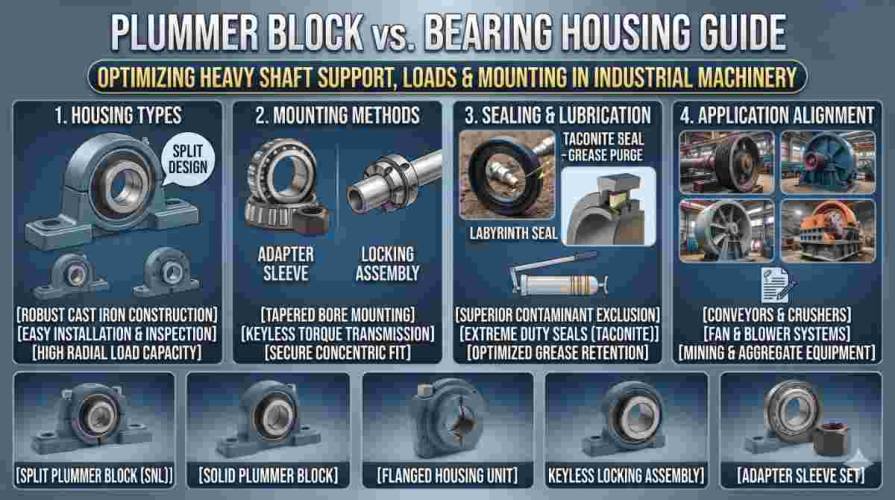
Bearing Housing (General): A broad term encompassing any stationary support for a bearing. Housings can be solid or split, plummer blocks, flanged units, take-up units, or customized plummer blocks designed for specific integrated machinery. They provide a clean, lubricated environment for the bearing insert (spherical, ball, or tapered roller).
-
Plummer Block (SNL / SAF Type): A specific, robust type of split bearing housing, typically made of cast iron or cast steel, designed to be bolted onto a flat surface (like a machine bed or floor).
-
Split Design (SNL / SAF): The housing cap can be removed from the base, simplifying installation, inspection, and maintenance of the bearing and shaft assembly without requiring the removal of the entire drive train.
-
High Load Capacity: Plummer blocks are engineered to withstand heavy radial loads and moderate axial loads, often associated with large conveyor pulleys, heavy fans, and mining equipment.
-
Sealing & Lubrication: They offer superior sealing options (labyrinth, taconite, or v-ring seals) to exclude heavy contaminants like dust, dirt, and moisture commonly found in industrial environments.
When Should You Use Adapter Sleeves or Locking Assemblies for Shaft Mounting?
Achieving a secure, concentric fit between the bearing and the shaft is paramount. Engineers must choose between traditional keyway mounting (often with an interference fit) and modern, keyless methods.
Use Adapter Sleeves When:
-
Using Tapered Bore Bearings: Adapter sleeves (complete with a locknut and washer) allow a tapered bore spherical roller bearing to be mounted onto a standard cylindrical shaft without requiring a precise, costly interference fit machining along the entire shaft seat.
-
Ease of Installation and Removal: The sleeve is tightened using the locknut, driving it into the bearing bore, creating a firm grip. This method is preferred in heavy industry where frequent mounting and dismounting for bearing replacement might be required.
-
Accommodating Shaft Tolerances: Adapter sleeves can accommodate slightly wider shaft tolerances than direct-mount interference fits.
Use Locking Assemblies (Keyless) When:
-
Transmitting High Torque: Precision locking assemblies (e.g., conical clamping rings) provide a zero-backlash, interference fit that is superior at transmitting very high torques and reversing loads without the stress concentrations associated with keys and keyways.
-
Protecting Shaft Integrity: By eliminating the keyway, the shaft maintains its full cross-sectional strength and fatigue resistance, which is crucial in high-speed or highly stressed applications.
-
Precise Axial Positioning: Locking assemblies allow for infinite axial and angular adjustment during installation, ensuring the coupling or pulley is perfectly positioned on the shaft before tightening.
What Housing Rigidity, Sealing, and Lubrication Factors Affect Heavy-Duty Reliability?
Selecting a heavy-duty housing is not solely about load rating; it encompasses the unit's ability to maintain its geometry under stress and protect the internal components.
-
Housing Rigidity: A robust, cast iron (or increasingly, ductile iron or cast steel) housing is essential to resist deflection under dynamic loads. If the housing flexes, the bearing will experience uneven load distribution, leading to premature fatigue and failure. Heavy-duty designs (like SNL/SD series) feature reinforced bases and caps for maximum stiffness.
-
Sealing Integrity: The effectiveness of the seal determines bearing life in harsh environments. While standard seals work in clean areas, heavy industry requires specialized sealing:
-
Labyrinth Seals: Provide non-contact, multi-stage labyrinth paths that are excellent for high-speed applications where contaminants are mainly airborne.
-
Taconite Seals: Heavy-duty, contact-and-labyrinth combination seals, often with a grease purge, designed for extremely dirty, abrasive, or wet conditions (e.g., mining, aggregate processing).
-
Lubrication Management: Heavy-duty housings are designed with effective grease reservoirs and relubrication points. The ability to purge old grease and introduce fresh lubricant helps flush out contaminants and maintain an optimal grease film within the bearing element.
What Details Should You Share When Ordering Plummer Blocks or Locking Assemblies?
To ensure you receive the correct components that fit your machinery and application, be prepared to specify the following critical parameters when contacting Anant Engineering:
-
Shaft Diameter: The exact metric or imperial shaft size (e.g., 100mm or 3-15/16 inches) that the bearing and locking device must accommodate.
-
Load and Speed: The magnitude and direction of radial and axial loads, along with the maximum operating RPM, to ensure the housing and bearing have the correct dynamic capacity.
-
Locking Method Preference: Whether you require a Plummer block with an adapter sleeve and locknut, or if a keyless locking assembly is needed for direct shaft mounting.
-
Environmental Conditions: Details on temperature extremes, presence of water, chemicals, or heavy abrasive dust, which will dictate the housing material and, crucially, the seal type.
-
Housing Type and Material: Specify if you need a standard split Plummer block (SNL, SAF), a solid block, or a flanged unit, and if standard cast iron is sufficient or if ductile iron/cast steel is required for higher shock loads.
How Can Anant Engineering Support Your Industrial Bearing Housing and Shaft Support Needs?
Anant Engineering (+91-702-141-8176, info@anantengineering.com, Vasai (E), Mumbai) manufactures and supplies a comprehensive range of power transmission components, including precision-machined Plummer Blocks (SNL and SAF series), Bearing Housings, Locking Assemblies, and Adapter Sleeves from our Mumbai facility for heavy industries across India and worldwide.
Whether you need a single split Plummer block for a conveyor retrofit or a complete shaft support package for a new crusher design, our engineering team is ready to assist. Explore our full product catalogue on our Products page, or Contact Us at +91-702-141-8176 to discuss your specific application requirements today.

 Industrial Couplings
 Industrial Gears
 Sprocket
 Industrial Roller Chain
 Pulleys
 Plummer Block
 Gearbox