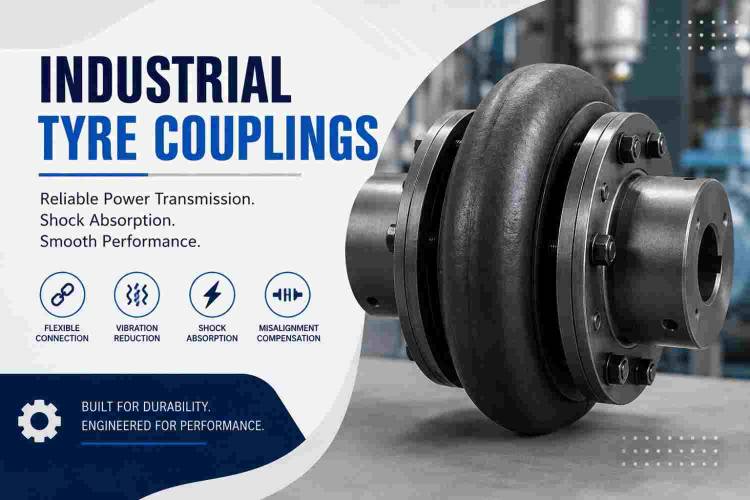
Industrial machinery depends on reliable power transmission components to operate efficiently, safely, and consistently. Among the various coupling solutions available, tyre couplings are widely used because they combine flexibility, shock absorption, and dependable torque transmission. They are designed to connect rotating shafts while helping compensate for certain types of shaft misalignment.
But what makes these couplings suitable for demanding industrial applications? How do they work, and what should industries consider when selecting the right option? This guide explains the key features, benefits, applications, and selection considerations of industrial tyre couplings.
What Is an Industrial Tyre Coupling?
An industrial tyre coupling is a flexible shaft coupling that uses a rubber or elastomeric tyre element to transmit torque between two shafts. The flexible tyre is positioned between coupling flanges, allowing the coupling to accommodate angular, parallel, and axial misalignment within its designed limits.
The elastomeric element also helps absorb shocks and vibrations generated during machine operation. This makes tyre couplings particularly useful in machinery where smooth power transmission and protection against operational disturbances are important.
Unlike rigid coupling designs, flexible tyre couplings provide a degree of resilience between connected shafts, helping reduce the transmission of harmful vibration and impact loads.
How Does a Tyre Coupling Work?
A tyre coupling works by transferring rotational force from one shaft to another through its flexible tyre element. The coupling consists primarily of hubs or flanges connected by the elastomeric tyre.
When the driving shaft rotates, torque is transferred through the tyre to the driven shaft. Because the tyre is flexible, it can deform slightly as the connected shafts experience movement or misalignment.
This flexibility allows the coupling to:
- Accommodate shaft misalignment
- Absorb shocks and torsional vibrations
- Reduce vibration transmission
- Provide smooth torque transmission
- Protect connected machinery from sudden load fluctuations
The coupling must, however, be selected according to the required torque, bore size, speed, and operating conditions.
Why Are Industrial Tyre Couplings Used in Machinery?
Industrial tyre couplings are used when machinery requires a combination of flexibility, torque transmission, and vibration absorption. Their resilient construction can help reduce the effects of starting shocks and cyclic loads.
They are particularly beneficial in applications where connected equipment may experience frequent starts, stops, load variations, or mechanical vibration.
Another important advantage is their ability to compensate for shaft misalignment. Minor misalignment can occur because of installation tolerances, thermal expansion, foundation movement, or normal operating conditions. A suitable flexible coupling can accommodate these movements within its specified limits.
For demanding machinery, choosing the correct coupling can contribute to improved equipment reliability and reduced mechanical stress.
What Are the Main Benefits of Industrial Tyre Couplings?
Industrial tyre couplings offer several operational benefits that make them suitable for a wide range of power transmission systems.
1. Flexible Misalignment Compensation
The flexible tyre element allows the coupling to accommodate permissible angular, parallel, and axial shaft movements. This can help reduce excessive forces on connected shafts and bearings.
2. Shock Absorption
The rubber or elastomeric element absorbs a portion of shock loads generated during operation. This is especially useful for machinery subjected to sudden changes in load.
3. Vibration Reduction
Tyre couplings can dampen torsional vibrations and help limit vibration transmission between connected machines. This can contribute to smoother operation.
4. Reliable Torque Transmission
When correctly selected and installed, tyre couplings provide dependable torque transmission for industrial power transmission applications.
5. Flexible Construction
The resilient tyre provides flexibility while maintaining the required connection between the driving and driven shafts.
6. Suitability for Various Applications
Different sizes and configurations can be selected according to shaft diameter, torque requirements, operating speed, and machine configuration.
Which Industries Use Industrial Tyre Couplings?
Industrial tyre couplings can be used across numerous sectors where rotating machinery requires flexible power transmission.
Typical applications include:
- Pumps
- Compressors
- Fans and blowers
- Conveyors
- Industrial drives
- Crushers
- Mixers
- Material-handling equipment
- Manufacturing machinery
- Marine equipment
- Heavy-duty rotating machinery
The exact suitability depends on the machine's torque, speed, load characteristics, shaft dimensions, and environmental conditions.
How Do You Select the Right Industrial Tyre Coupling?
Selecting a coupling should begin with understanding the operating requirements of the machinery. A coupling that is too small may not handle the transmitted torque, while an unnecessarily oversized coupling can increase cost and installation requirements.
Important factors include:
Torque: Determine the normal and peak torque requirements of the application.
Bore Size: The coupling bore must be compatible with the shafts being connected.
Speed: Check the coupling's permissible operating speed against the machine's rotational speed.
Misalignment: Consider the expected angular, parallel, and axial misalignment.
Load Characteristics: Machines with frequent starts, stops, shocks, or fluctuating loads may require additional consideration.
Environment: Temperature, dust, moisture, chemicals, and other environmental conditions can influence elastomer selection and coupling performance.
Installation Requirements: Consider available space, shaft arrangement, and maintenance accessibility before final selection.
What Specifications Should You Check Before Buying a Tyre Coupling?
Product specifications provide essential information for determining whether a coupling is suitable for a particular machine.
For example, a tyre coupling range may include different coupling sizes with varying bore, outside diameter, and torque capacities. One available F-Type range is specified from F-40 to F-250, with bore sizes from 11 mm to 190 mm, diameters from 104 mm to 628 mm, and torque ratings from 21 Nm to 42,740 Nm.
These specifications demonstrate why coupling selection should be based on the actual machine requirements rather than simply choosing a coupling based on shaft diameter.
It is also important to review technical documentation and manufacturer recommendations before installation.
Why Is Proper Installation Important for Tyre Couplings?
Correct installation is essential for achieving the expected performance and service life of a flexible coupling. Even a high-quality coupling can experience premature wear if shafts are incorrectly aligned or the coupling is installed outside its specified operating conditions.
Before installation, shaft dimensions, alignment, mounting arrangements, and operating requirements should be checked carefully. The coupling should be installed according to the manufacturer's technical instructions.
Regular inspection can also help identify signs of tyre deterioration, excessive wear, cracking, or other issues before they affect machinery operation.
How Can Tyre Couplings Support Efficient Power Transmission?
A flexible coupling does more than simply connect two shafts. By absorbing vibration and accommodating permissible misalignment, it can help reduce unnecessary mechanical stress within a power transmission system.
This can support smoother machinery operation and help protect associated components such as shafts, bearings, and connected drive equipment.
For businesses looking for a broader range of power transmission products, Industrial Couplings can be considered alongside other coupling solutions based on the specific requirements of the application.
What Makes a Quality Industrial Tyre Coupling Important?
A quality tyre coupling should be manufactured with suitable materials, accurate dimensions, and appropriate quality-control procedures. The flexible element must be capable of handling the expected operating conditions while the coupling assembly must provide reliable torque transmission.
Engineering expertise is also important because industrial applications can differ considerably in terms of torque, speed, misalignment, load cycles, and environmental exposure.
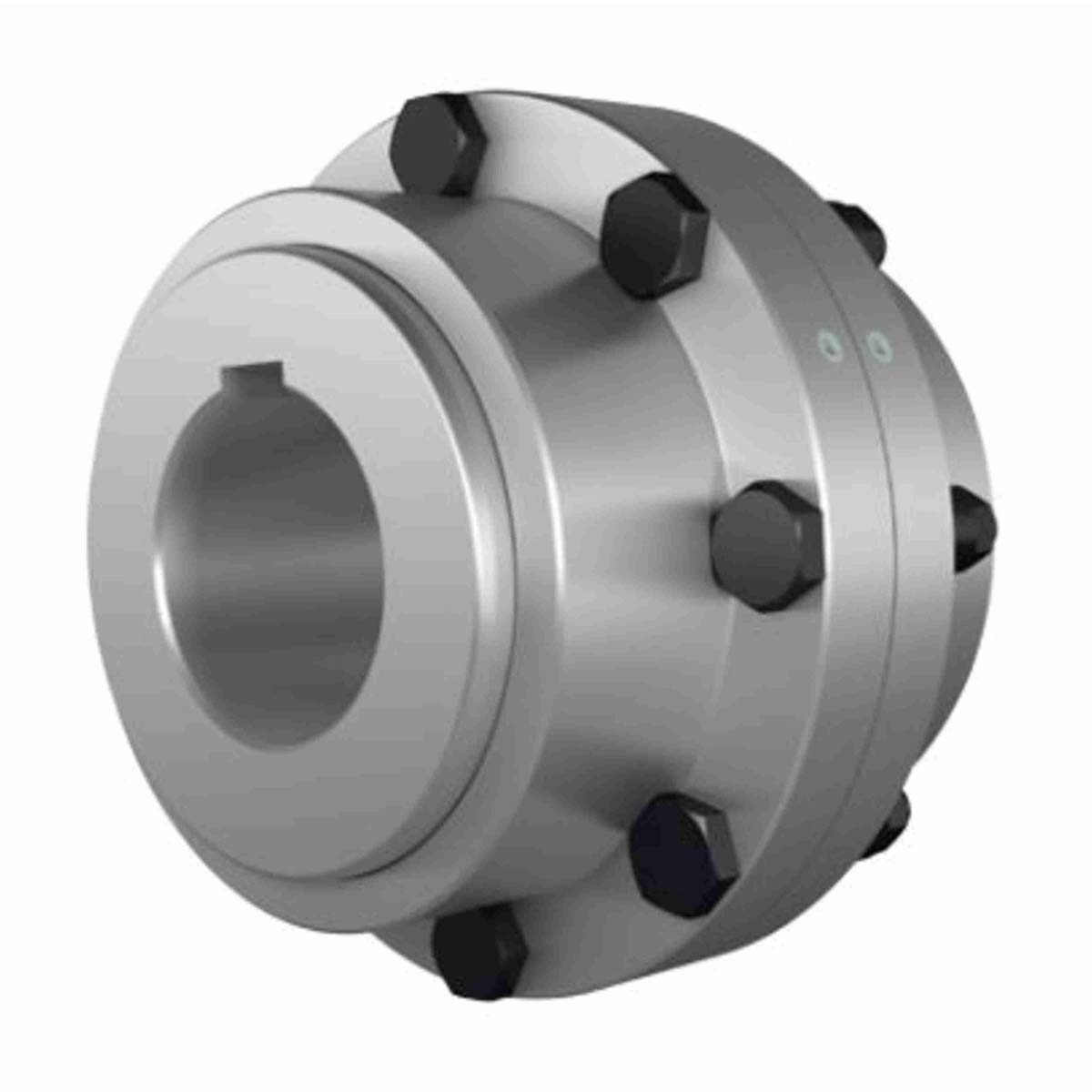
For applications requiring different coupling characteristics, alternatives such as Gear Coupling, Jaw Couplings, Pin Bush Couplings, or Resilient Spring Grid Coupling may also be evaluated.
Where Can You Find Industrial Tyre Couplings for Different Applications?
Industrial tyre couplings are available in multiple sizes and configurations to accommodate different machinery requirements. A suitable product should be selected by evaluating torque capacity, bore dimensions, operating speed, misalignment, and load conditions.
A manufacturer with a broad industrial coupling portfolio can help businesses identify an appropriate solution based on their equipment specifications.
For specialized requirements, it is advisable to provide complete machine details, including shaft size, operating speed, transmitted power, torque, and application type, when requesting a quotation.
Conclusion: Are Industrial Tyre Couplings a Reliable Power Transmission Solution?
Yes, industrial tyre couplings can be a reliable solution for machinery requiring flexible power transmission, shock absorption, vibration damping, and misalignment compensation. Their elastomeric construction makes them suitable for many industrial drive applications where smooth and dependable operation is important.
The key to achieving good performance is selecting the correct coupling according to torque, speed, bore, misalignment, load characteristics, and environmental conditions. Proper installation and periodic inspection are equally important for maintaining coupling performance.
With the right specification and application-based selection, industrial tyre couplings can contribute to reliable power transmission and help support the long-term performance of connected machinery.

 Industrial Couplings
 Industrial Gears
 Sprocket
 Industrial Roller Chain
 Pulleys
 Plummer Block
 Gearbox