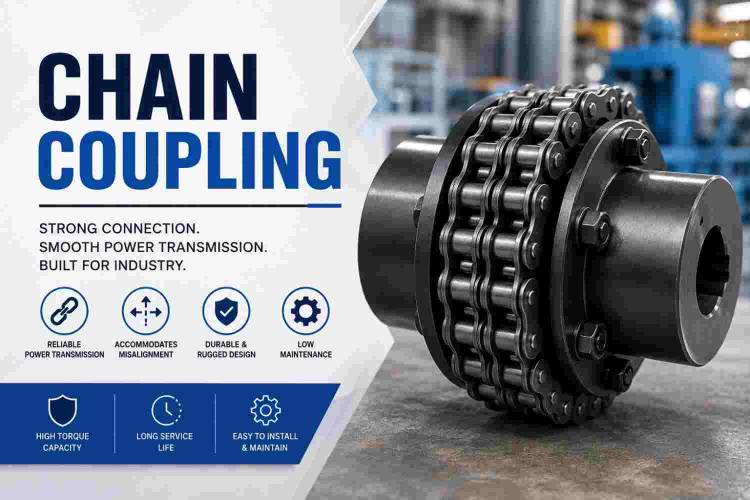
Industrial machinery requires dependable power transmission components to maintain smooth and efficient operation. Chain couplings are widely used for connecting rotating shafts and transmitting torque between driving and driven equipment. Their simple construction, durable design, and ability to accommodate certain shaft misalignments make them suitable for a wide range of industrial applications.
But what exactly is a chain coupling, how does it work, and why is it preferred for certain machinery? Understanding its construction, benefits, applications, and selection factors can help industries choose the right coupling for their power transmission requirements.
What Is a Chain Coupling?
A chain coupling is a mechanical device used to connect two shafts and transmit rotational power from one shaft to another. It generally consists of two sprocket-like hubs mounted on the shafts and a roller chain that engages with both hubs.
The chain provides the mechanical connection between the two hubs, allowing torque to be transmitted while accommodating a limited amount of shaft misalignment.
A protective cover may also be used around the chain to improve safety and help protect the coupling from contaminants. Proper lubrication and maintenance can further support reliable operation and extend the service life of the coupling.
How Does a Chain Coupling Work?
A chain coupling transfers torque through the engagement between its sprocket hubs and roller chain. When the driving shaft rotates, its hub rotates with it and transfers the rotational force through the chain to the hub mounted on the driven shaft.
This arrangement provides a straightforward and effective method of transmitting mechanical power.
Because the chain has a degree of flexibility, the coupling can accommodate certain angular and parallel shaft misalignments. However, it is important to operate the coupling within the manufacturer's specified limits.
The simple mechanical design also makes chain couplings relatively easy to inspect, install, and maintain when compared with some more complex coupling arrangements.
Why Are Chain Couplings Used in Industrial Machinery?
Chain couplings are used because they provide reliable torque transmission while offering practical flexibility and a relatively compact construction.
They are particularly useful in machinery where moderate shaft misalignment, shock loads, and reliable power transmission are important considerations.
Some key reasons for using chain couplings include:
- Efficient torque transmission
- Simple and robust construction
- Ability to accommodate limited shaft misalignment
- Easy installation and maintenance
- Suitable for a variety of industrial drives
- Availability in multiple sizes
- Practical solution for demanding mechanical applications
The correct coupling should always be selected according to the operating requirements of the connected machinery.
What Are the Main Advantages of Chain Couplings?
Chain couplings offer several advantages for industrial power transmission systems.
1. Reliable Torque Transmission
The roller chain and sprocket hubs create a positive mechanical connection that allows torque to be transferred effectively between connected shafts.
2. Misalignment Compensation
Chain couplings can accommodate a limited degree of angular and parallel misalignment. This flexibility can help manage minor alignment variations during machinery operation.
3. Simple Construction
Their relatively straightforward design makes chain couplings easy to understand, install, inspect, and maintain.
4. Durable Performance
When manufactured from suitable materials and used within their recommended operating limits, chain couplings can provide dependable performance in industrial environments.
5. Maintenance-Friendly Design
The chain and hubs can generally be inspected for wear, while lubrication can be performed as part of a suitable maintenance schedule.
6. Versatile Applications
Chain couplings can be used with various types of rotating machinery where their torque, speed, bore, and misalignment capabilities meet the application requirements.
What Is a Roller Chain Coupling?
A roller chain coupling is a type of chain coupling that uses a roller chain to connect two toothed or sprocket-style hubs. The roller chain engages with both hubs and transfers rotational force from the driving shaft to the driven shaft.
Its design combines mechanical strength with a certain amount of flexibility. This makes roller chain couplings suitable for many industrial power transmission systems.
The performance of a roller chain coupling depends on factors such as chain size, hub dimensions, transmitted torque, operating speed, lubrication, and environmental conditions.
For applications requiring reliable mechanical connections, Roller Chain Couplings can be selected according to the specific requirements of the machinery.
Which Machines Use Chain Couplings?
Chain couplings are used in a wide range of rotating machinery and industrial drive systems.
Typical applications include:
- Pumps
- Conveyors
- Compressors
- Fans and blowers
- Mixers
- Industrial drives
- Material-handling equipment
- Manufacturing machinery
- General mechanical power transmission systems
- Heavy-duty rotating equipment
The suitability of a chain coupling depends on the machine's operating conditions. Applications involving high shock loads, high speeds, or demanding environments should be evaluated carefully before selecting the coupling.
How Do You Select the Right Chain Coupling?
Selecting the right chain coupling requires consideration of several technical parameters. The coupling must be capable of handling the required torque and operating speed while fitting the connected shafts correctly.
Important selection factors include:
Torque Capacity: Determine the normal and peak torque generated by the machinery.
Bore Size: Check that the coupling bore matches the shaft diameters or the specified mounting arrangement.
Operating Speed: Ensure that the coupling's permissible speed is suitable for the machine.
Misalignment: Consider the expected angular and parallel shaft misalignment.
Load Conditions: Machinery with frequent starts, stops, reversing, or shock loads may require additional coupling capacity.
Environment: Dust, moisture, chemicals, temperature, and other environmental conditions can affect coupling performance and maintenance requirements.
Lubrication: Follow appropriate lubrication recommendations to reduce wear between the chain and sprocket components.
What Specifications Should You Check Before Buying a Chain Coupling?
Technical specifications are essential when choosing a chain coupling because different sizes are designed for different shaft and torque requirements.
For example, one available chain coupling range extends from CC-6112 to CC-4022, with bore sizes from 10 mm to 260 mm and diameters from 65 mm to 517 mm.
These specifications demonstrate the importance of matching the coupling to the actual machine requirements. Selecting a coupling solely based on shaft diameter may not provide sufficient information for reliable operation.
Torque requirements, speed, bore dimensions, coupling diameter, load characteristics, and installation conditions should all be evaluated before purchasing.
Why Is Proper Maintenance Important for Chain Couplings?
Proper maintenance helps chain couplings deliver consistent performance and can reduce the risk of unexpected equipment downtime.
Regular inspection should focus on the condition of the chain, sprocket hubs, fasteners, lubrication, and protective components. Signs of excessive wear, corrosion, looseness, or abnormal noise should be investigated promptly.
Adequate lubrication is particularly important because the chain and sprocket surfaces operate through repeated mechanical engagement. Following the manufacturer's maintenance recommendations can help minimize unnecessary wear.
Proper shaft alignment should also be maintained because excessive misalignment can increase mechanical stress and accelerate component deterioration.
How Do Chain Couplings Compare With Other Industrial Couplings?
Different coupling designs are developed for different mechanical requirements. Chain couplings are particularly useful where straightforward torque transmission, durability, and practical maintenance are priorities.
However, applications requiring different levels of flexibility, vibration damping, precision, or misalignment compensation may benefit from other coupling designs.
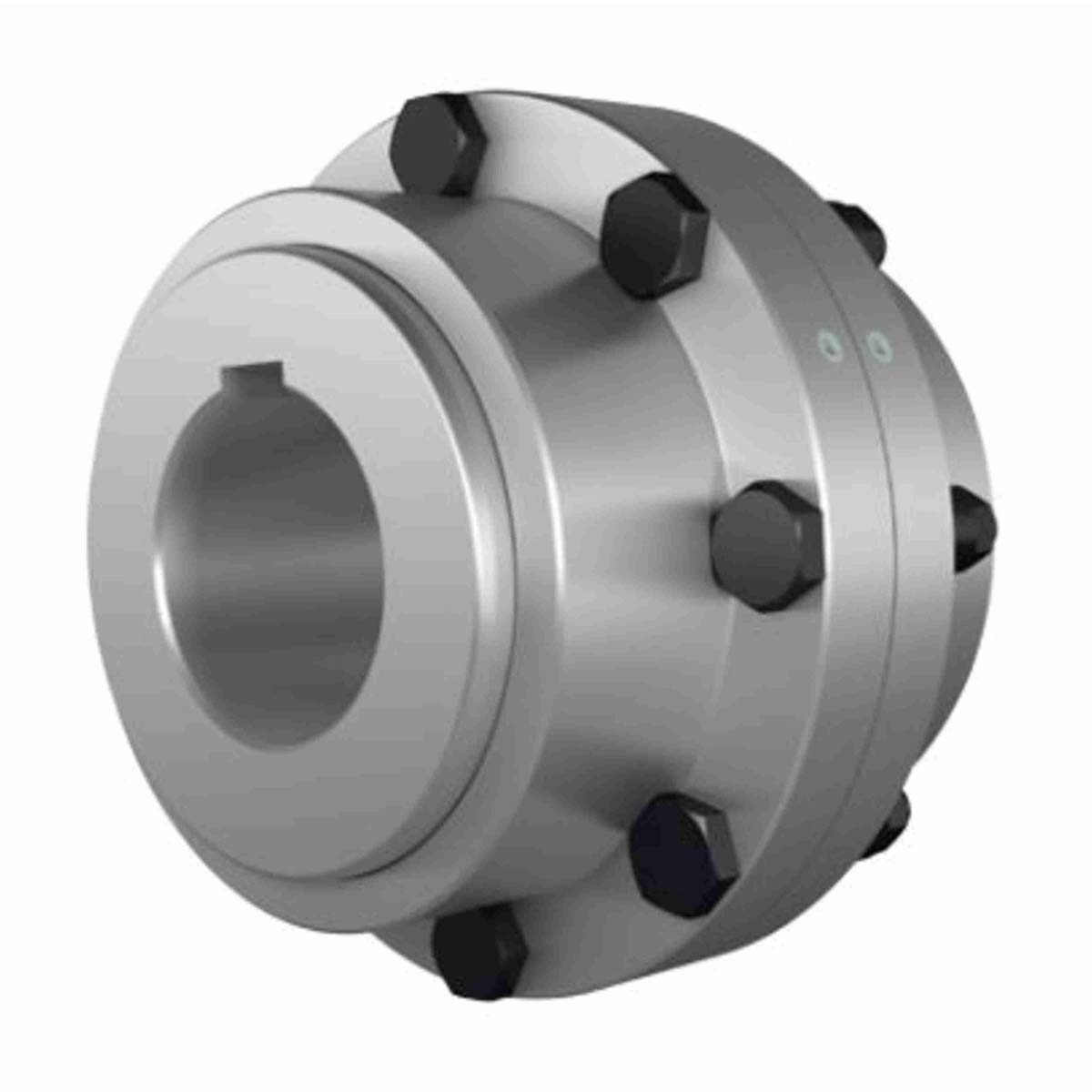
For example, Industrial Couplings provide access to a broader range of power transmission solutions. Depending on the machinery requirements, options such as Gear Coupling, Jaw Couplings, Pin Bush Couplings, and Industrial Tyre Couplings may also be considered.
The best choice depends on the application rather than simply selecting the most robust coupling available.
What Makes a Quality Chain Coupling Important?
A quality chain coupling should provide accurate dimensions, reliable materials, proper manufacturing, and consistent performance under its intended operating conditions.
Manufacturing quality is important because the hubs and chain must work together accurately to transmit torque. The coupling should also be selected and installed according to the manufacturer's technical specifications.
For specialized applications, providing details such as shaft diameter, operating speed, transmitted power, torque, and application type can help in identifying an appropriate coupling.
Are Chain Couplings a Reliable Solution for Industrial Applications?
Yes, chain couplings can be a reliable and practical solution for many industrial power transmission applications. Their roller-chain construction provides effective torque transmission while allowing limited shaft misalignment.
Their simple design, durable construction, maintenance-friendly characteristics, and availability in different sizes make them suitable for a broad range of rotating machinery.
However, long-term performance depends on correct sizing, proper installation, suitable lubrication, alignment, and regular inspection. By evaluating these factors before selection, industries can choose a chain coupling that supports dependable machinery operation and efficient power transmission.

 Industrial Couplings
 Industrial Gears
 Sprocket
 Industrial Roller Chain
 Pulleys
 Plummer Block
 Gearbox