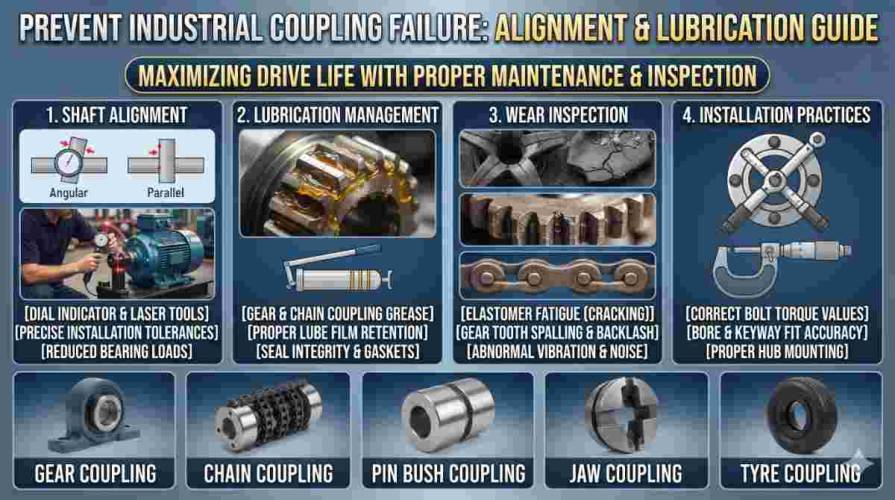
Unplanned coupling failures rarely happen without warning. In pumps, compressors, conveyors, blowers, and heavy process machinery, premature wear in gear teeth, roller chains, rubber bushes, or elastomeric elements usually traces back to preventable mechanical stresses—most commonly shaft misalignment, neglected lubrication, or missed routine inspections.
Combining accurate installation tolerances with scheduled lubrication and condition checks keeps torque transfer smooth, protects connected motor and gearbox bearings, and extends coupling service life across demanding industrial shifts.
How Do Angular, Parallel, and Axial Misalignment Shorten Coupling and Bearing Life?
Angular, parallel, and axial misalignment shorten coupling and bearing life by forcing flexible elements, gear teeth, or chain rollers to absorb cyclic bending and sliding forces during every shaft revolution—generating excess heat, accelerating component wear, and transferring destructive radial and axial loads directly into adjacent motor and gearbox bearings.
-
Angular Misalignment: Occurs when two shaft centerlines intersect at an angle rather than running collinear, causing uneven tooth loading on gear couplings or edge compression on elastomeric spiders and pin bushes.
-
Parallel (Offset) Misalignment: Happens when shaft axes remain parallel but are displaced vertically or horizontally, creating twice-per-revolution flexing that fatigues rubber tyres, jaws, and chain links.
-
Axial Misalignment (End Float): Develops when thermal expansion in hot pumps, turbines, or compressors pushes shafts closer together or pulls them apart beyond the coupling's rated axial travel.
-
Precision Alignment Checks: Using dial indicators or laser alignment tools during installation and after thermal warm-up keeps shaft offsets well within manufacturer limits, even when using flexible couplings.
Why Does Proper Lubrication Matter for Gear and Chain Couplings Under Heavy Loads?
Proper lubrication matters for metallic gear and chain couplings because continuous metal-to-metal sliding contact between crowned gear teeth or roller chain pins and sprockets generates high frictional heat; maintaining the right grease or oil film prevents scuffing, pitting, and rapid pitch wear under high torque.
-
Gear Coupling Grease Selection: High-viscosity, extreme-pressure (EP) coupling greases resist centrifugal separation at operating RPM, ensuring lubricant stays trapped inside the meshing hub and sleeve teeth rather than flinging outward.
-
Chain Coupling Maintenance: Applying appropriate heavy-duty grease inside a properly sealed chain coupling casing reduces pin-bushing friction and protects rollers against moisture and abrasive plant dust.
-
Seal & Gasket Integrity: Checking O-rings, end gaskets, and grease plugs during servicing prevents lubricant leakage and stops grit or process contaminants from entering the wear zone.
-
Non-Lubricated Elastomeric Options: Where maintenance access is limited, elastomeric designs such as jaw, tyre, and pin bush couplings eliminate lubrication requirements altogether while cushioning shock loads.
What Elastomer, Tooth, or Pin Wear Signs Should Technicians Check During Routine Downtime?
During routine downtime, technicians should inspect couplings for elastomeric cracking or powdering, gear tooth pitting or backlash, chain elongation, loose hub fasteners, and abnormal grease discoloration—catching early mechanical degradation before it escalates into sudden torque loss or secondary equipment damage.
-
Elastomeric Element Fatigue: Look for hardening, surface cracks, swelling from oil exposure, or rubber dust ("powdering") around pin bush, jaw spider, or tyre elements, which signals excessive misalignment, overload, or chemical incompatibility.
-
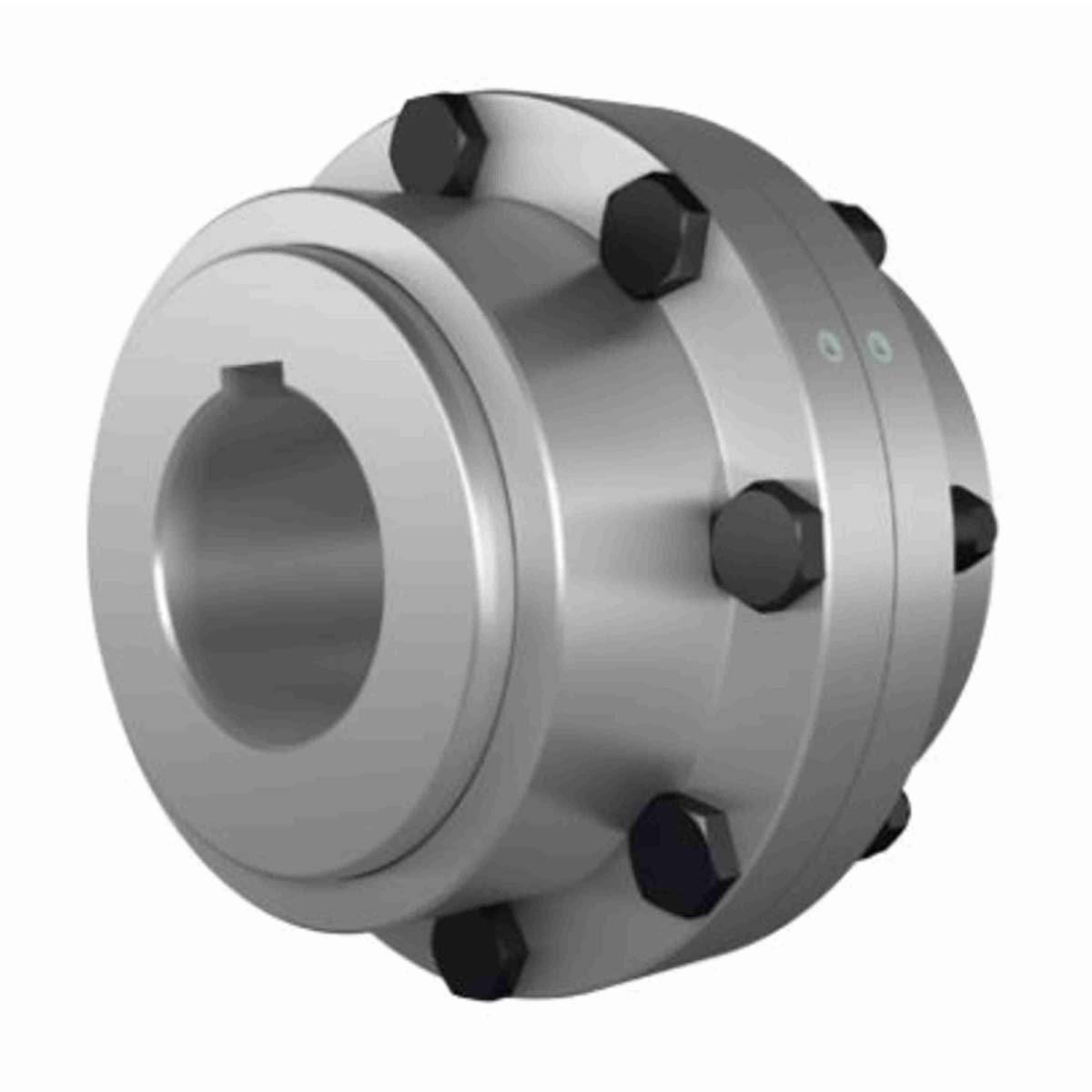
Gear Tooth & Chain Wear: Inspect gear coupling hubs and sleeves for step wear, spalling, or increased rotational backlash, and check chain couplings for elongated links or hooked sprocket teeth.
-
Fretting Corrosion & Loose Fasteners: Reddish-brown oxide dust near hub bores, keyways, or flange bolts indicates micro-movement caused by improper shaft fit or under-torqued clamping hardware.
-
Abnormal Vibration & Noise: Sudden increases in axial vibration, metallic knocking during start-stop cycles, or elevated housing temperatures warrant immediate alignment and element inspection.
How Do Installation Practices and Bore/Keyway Accuracy Prevent Premature Breakdowns?
Accurate bore tolerances, properly fitted keys, and disciplined installation practices prevent premature breakdowns by keeping coupling hubs concentric with shaft centerlines and ensuring full-surface torque transfer—eliminating hub wobbling, keyway hammering, and uneven dynamic loads at high rotational speeds.
-
Precision Bore & Keyway Fit: Matching hub bore tolerances (such as interference or transition fits) and parallel key dimensions to shaft specifications prevents radial play and key rocking under reversing or shock loads.
-
Controlled Hub Mounting: Heating hubs evenly or using proper mechanical pullers—rather than hammering directly on coupling flanges or teeth—avoids brinelling bearings and distorting hub geometry.
-
Verified Bolt Torque & Spacing: Maintaining the specified hub gap (DBSE) and tightening flange or clamping ring bolts in a cross-pattern to recommended torque values keeps rotating assemblies balanced and secure.
How Can Anant Engineering Support Your Industrial Coupling and Drivetrain Requirements?
Anant Engineering (+91-702-141-8176, info@anantengineering.com, Vasai (E), Mumbai) manufactures and supplies precision-machined Industrial Couplings—including gear couplings, chain couplings, pin bush couplings, jaw couplings, and tyre couplings—alongside industrial gears, sprockets, roller chains, and plummer blocks for OEMs and process plants across India and global markets.
Whether you need replacement coupling elements, custom-bored hubs, or complete power transmission assemblies built for reliable operation, our technical team is ready to assist. Explore more engineering guides on our Blogs page, or Contact Us at +91-702-141-8176 to discuss your application requirements today.

 Industrial Couplings
 Industrial Gears
 Sprocket
 Industrial Roller Chain
 Pulleys
 Plummer Block
 Gearbox