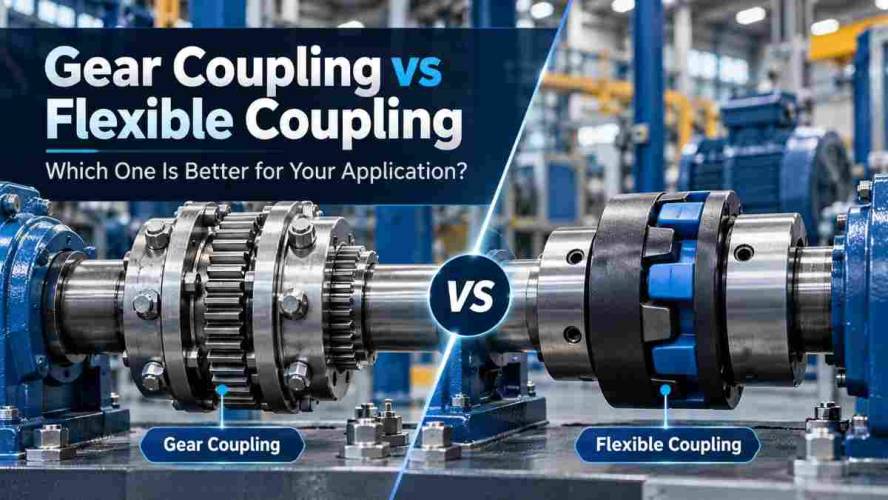
Choosing the right coupling is an important part of designing or maintaining an industrial power-transmission system.
A coupling connects two rotating shafts and transfers torque between them, but different coupling designs behave differently under load, vibration and shaft misalignment.
Two terms frequently encountered during coupling selection are gear coupling and flexible coupling.
However, they are not always direct opposites.
A gear coupling itself can provide a degree of flexibility, while the term flexible coupling covers several designs including jaw, tyre, pin bush, chain and disc couplings.
Understanding the differences in construction, torque capacity, maintenance and operating characteristics can make gear coupling vs flexible coupling selection much easier.
What Is a Gear Coupling?
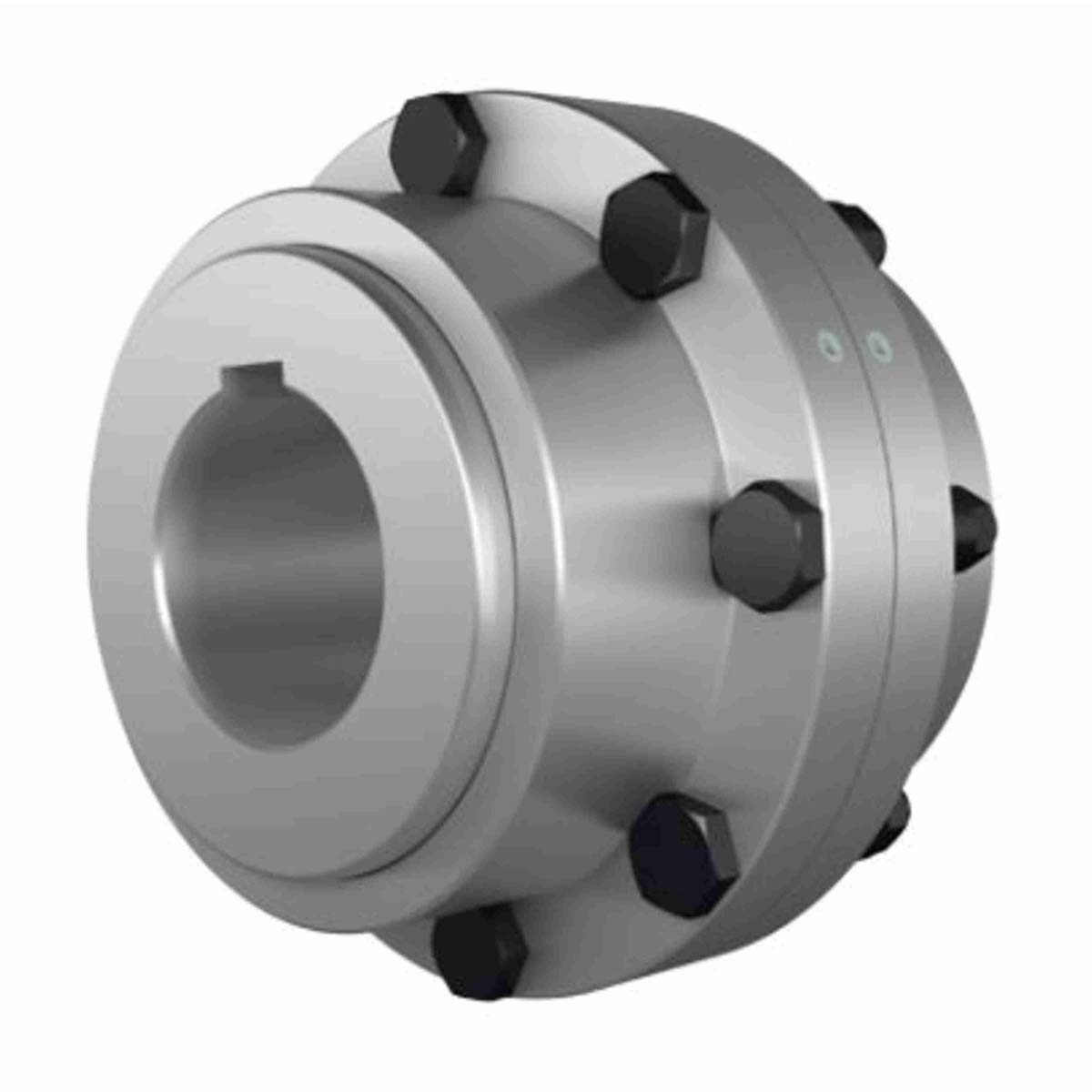
A gear coupling is a mechanical shaft coupling that transmits torque through mating gear teeth.
Its basic construction generally includes:
The toothed engagement allows substantial torque to be transmitted within a relatively compact coupling.
Gear couplings can also accommodate limited angular, parallel and axial movement depending on their design and operating limits.
This combination of torque capacity and controlled flexibility makes them common in demanding industrial power-transmission systems.
Anant Engineering offers dedicated Gear Couplings for industrial machinery and power-transmission applications.
What Is a Flexible Coupling?
A flexible coupling is a broader category of coupling designed to provide some flexibility between connected shafts.
Depending on its construction, a flexible coupling may help accommodate:
Flexible couplings can use several different mechanisms.
For example, flexibility may come from:
-
Elastomeric spiders
-
Rubber tyres
-
Flexible bushes
-
Metallic discs
-
Grid elements
-
Chains
-
Flexible sleeves
Because these designs behave differently, selecting a flexible coupling requires more than simply looking for the word "flexible."
The complete Industrial Couplings range from Anant Engineering includes several configurations intended for different machinery requirements.
What Is the Main Difference Between Gear Coupling and Flexible Coupling?
The biggest difference is that gear coupling describes a specific mechanical design, while flexible coupling describes a broader category.
A gear coupling transfers torque through gear teeth.
A flexible coupling may transfer torque through an elastomeric element, bush, tyre, disc, chain or another flexible component.
Therefore, comparing them requires looking at practical performance factors such as:
-
Torque capacity
-
Misalignment
-
Vibration absorption
-
Shock resistance
-
Speed
-
Maintenance
-
Application type
Gear Coupling vs Flexible Coupling: Quick Comparison
| Factor |
Gear Coupling |
Flexible Coupling |
| Torque capacity |
Often suitable for high torque |
Depends heavily on coupling type |
| Construction |
Geared hubs and sleeves |
Elastomeric, metallic or mechanical flexible element |
| Misalignment |
Limited controlled accommodation |
Often designed specifically for misalignment |
| Shock absorption |
Moderate depending on design |
Can be high with elastomeric designs |
| Vibration damping |
Limited compared with elastomeric couplings |
Often better with jaw, tyre or bush designs |
| Maintenance |
May require lubrication/inspection |
Depends on design |
| Heavy-duty use |
Common |
Depends on specific coupling |
| Compact torque density |
Often high |
Varies by design |
The correct option therefore depends on the operating requirements rather than one coupling being universally better.
Which Coupling Can Handle More Torque?
For demanding industrial applications, gear couplings are frequently selected where substantial torque must be transmitted through a compact coupling arrangement.
Their metallic geared construction can make them suitable for heavy machinery and large drive systems.
Common applications may include:
-
Heavy conveyors
-
Steel-processing equipment
-
Rolling machinery
-
Large gearboxes
-
Material-handling systems
-
Mining equipment
-
Industrial process machinery
That does not mean every gear coupling automatically handles more torque than every flexible coupling.
Torque capacity depends on the exact size, material and design.
However, when high torque transmission is one of the main requirements, gear coupling is often one of the designs evaluated first.
Which Coupling Is Better for Shaft Misalignment?
Flexible coupling designs are commonly used where limited shaft misalignment needs to be accommodated.
The correct choice depends on whether the misalignment is:
-
Angular
-
Parallel
-
Axial
-
A combination of these
Different coupling designs have different permissible movement.
For example, Industrial Tyre Couplings use a flexible tyre element that can accommodate angular, parallel and axial movement within their design limits. They can also help absorb shock and vibration.
Gear couplings can also accommodate limited misalignment because the geared elements allow controlled relative movement.
However, no coupling should be used as a substitute for proper shaft alignment.
Excessive misalignment can shorten the life of:
-
Couplings
-
Bearings
-
Seals
-
Shafts
-
Gearboxes
-
Motors
Which Coupling Is Better for Vibration?
For machinery where vibration damping is a major requirement, elastomeric flexible couplings are often worth considering.
Examples include:
-
Jaw couplings
-
Tyre couplings
-
Pin bush couplings
These designs use flexible materials to reduce the amount of vibration transmitted between connected equipment.
A Pin Bush Coupling, for example, uses flexible bushes and is commonly applied where shock and vibration need to be absorbed. Anant Engineering's coupling content also describes pin bush couplings as suitable for vibration damping and minor misalignment.
Gear couplings primarily focus on dependable mechanical torque transmission rather than elastomeric vibration isolation.
Therefore, where vibration is the dominant concern, another flexible design may be more appropriate.
Gear Coupling vs Jaw Coupling: What's the Difference?
A Jaw Coupling generally consists of two hubs connected through an elastomeric spider.
The spider provides flexibility and helps absorb vibration and shock.
A gear coupling, by contrast, transfers torque through geared metal components.
Gear Couplings May Be Preferred When:
-
High torque capacity is important
-
Heavy machinery is involved
-
A compact mechanical connection is required
-
Strong metallic construction is preferred
Jaw Couplings May Be Preferred When:
-
Vibration damping is important
-
The application is light or medium duty
-
Simple construction is preferred
-
Shock cushioning is useful
Neither is automatically better.
The choice depends on torque, RPM, shaft diameter and operating environment.
Gear Coupling vs Tyre Coupling: Which Is Better?
A tyre coupling uses a flexible elastomeric tyre between the hubs.
This construction allows the tyre to deform slightly as shafts move or vibration occurs.
Anant Engineering describes tyre couplings as useful where flexibility, shock absorption and misalignment accommodation are important.
Gear Couplings
Typically prioritize:
-
High torque transmission
-
Mechanical strength
-
Compact construction
-
Heavy-duty service
Tyre Couplings
Typically prioritize:
For a high-torque heavy drive, a gear coupling may be appropriate.
For machinery experiencing vibration, shock and regular small alignment changes, a tyre coupling may be worth evaluating.
Gear Coupling vs Pin Bush Coupling
A pin bush coupling transmits torque using pins fitted with flexible bushes.
These bushes provide resilience between the connected shafts.
Pin bush couplings can therefore help absorb:
Anant Engineering describes pin bush couplings as being used in pumps, compressors, conveyors and heavy machinery where shock absorption and flexibility are valuable.
Gear couplings differ because their torque transmission occurs through gear teeth rather than flexible bushes.
The choice depends on whether the application places greater emphasis on heavy torque transmission or flexible shock absorption.
Gear Coupling vs Disc Coupling
A Disc Coupling uses thin metallic discs to provide flexibility.
Unlike an elastomeric coupling, it remains a metallic connection.
Disc couplings may be useful where:
-
Precise torque transmission is required
-
Controlled shaft flexibility is needed
-
High-speed rotation is involved
-
Elastomeric elements are undesirable
Gear couplings can often handle heavy torque loads but may involve different maintenance and lubrication requirements.
Disc couplings can provide a different balance between precision, flexibility and maintenance.
Gear Coupling vs Chain Coupling
A Chain Coupling generally consists of two sprocket-type hubs connected by roller chain.
Anant Engineering notes that chain couplings can accommodate minor misalignment while providing durable torque transmission and relatively straightforward maintenance.
Compared with a gear coupling:
Gear coupling
Chain coupling
-
Uses roller chain and sprocket-style hubs
-
Has relatively simple construction
-
Can be easy to assemble and service
-
May suit many general-purpose industrial drives
Which Coupling Is Better for Shock Loads?
Machines such as crushers, mixers, conveyors and material-handling systems can experience sudden variations in torque.
In such cases, a coupling that offers shock absorption can help reduce peak forces transferred between components.
Elastomeric couplings such as tyre, jaw or pin bush designs may provide more cushioning than a fully metallic gear coupling.
However, if the same application also requires very high torque capacity, engineers need to balance both requirements.
This is why coupling selection should be based on actual operating data rather than a single factor.
Which Coupling Requires More Maintenance?
Maintenance varies considerably between coupling designs.
Traditional gear couplings may require:
-
Lubrication
-
Seal inspection
-
Gear-tooth inspection
-
Fastener checks
-
Alignment checks
Flexible elastomeric couplings may require:
-
Spider inspection
-
Bush inspection
-
Tyre inspection
-
Fastener checks
-
Alignment monitoring
A chain coupling may require chain and lubricant inspection.
A disc coupling may require examination for disc fatigue or damage.
So there is no universal rule that flexible couplings require less maintenance.
The maintenance burden depends on the specific design and operating environment.
Which Coupling Is Better for High-Speed Machinery?
Speed should always be checked against the manufacturer's coupling rating.
Some metallic flexible couplings, such as disc couplings, may be considered for applications where high rotational speeds and accurate torque transmission are required.
Gear couplings can also operate at significant speeds when correctly selected and maintained.
Important factors include:
-
Coupling balance
-
Shaft alignment
-
Lubrication
-
Rotational inertia
-
Bore dimensions
-
Operating temperature
Never select a coupling solely based on its construction type for a high-speed application.
Which Coupling Is Better for Pumps?
Pump applications vary widely.
Possible coupling options include:
-
Jaw couplings
-
Pin bush couplings
-
Disc couplings
-
Spacer couplings
-
Gear couplings
For general pump systems where vibration damping is useful, a jaw or pin bush coupling may be suitable.
For pumps where maintenance access is important, Spacer Couplings can provide separation between the driving and driven equipment while maintaining torque transmission. Anant Engineering's spacer coupling pages specifically describe their use in pumps, compressors and service-critical installations.
The final choice depends on torque, pump speed, alignment and maintenance requirements.
Which Coupling Is Better for Conveyors?
Conveyors often operate continuously and may experience changing loads.
Possible options include:
-
Gear couplings
-
Pin bush couplings
-
Chain couplings
-
Tyre couplings
-
Jaw couplings
Heavy-duty conveyors may require higher torque capacity and robust metallic components.
Conveyors with frequent starts, stops or load changes may benefit from additional shock absorption.
The conveyor's actual operating data should determine which coupling type is most suitable.
When Should You Choose a Gear Coupling?
A gear coupling may be considered when:
-
High torque needs to be transmitted
-
Heavy-duty machinery is involved
-
Compact torque transmission is required
-
Metallic construction is preferred
-
Limited shaft misalignment needs to be accommodated
-
The maintenance system can support its inspection requirements
Gear couplings are widely associated with demanding industrial applications where strength and torque capacity are priorities.
When Should You Choose Another Flexible Coupling?
A different flexible coupling may be more appropriate when:
-
Vibration damping is a major concern
-
Shock loads are frequent
-
Greater flexibility is required
-
Maintenance simplicity is important
-
The equipment is relatively light or medium duty
-
Elastomeric cushioning is beneficial
Potential options include:
Each provides a different combination of flexibility, torque transmission and operating characteristics.
What Information Should You Check Before Selecting Either Coupling?
Before deciding between a gear coupling and another flexible coupling, gather:
-
Motor power
-
Operating RPM
-
Required torque
-
Starting torque
-
Peak load
-
Shaft diameters
-
Keyway dimensions
-
Type of misalignment
-
Available installation space
-
Operating temperature
-
Vibration levels
-
Shock loading
-
Maintenance accessibility
-
Environmental conditions
This information provides a much stronger basis for coupling selection than comparing product names alone.
Gear Coupling vs Flexible Coupling: Which Should You Choose?
There is no single answer that applies to every machine.
A gear coupling can be a strong choice for applications requiring substantial torque transmission and robust metallic construction.
Other flexible coupling designs may be more suitable where vibration damping, shock absorption or additional flexibility is a priority.
The most effective approach is to evaluate the machine's torque, speed, misalignment, vibration and maintenance requirements before selecting a coupling.
Anant Engineering supplies a broad range of Industrial Couplings, allowing businesses to evaluate gear, jaw, pin bush, tyre, chain, disc and other coupling configurations based on their machinery requirements.
Choosing according to operating conditions rather than coupling type alone can help improve power-transmission reliability and reduce unnecessary mechanical stress.

 Industrial Couplings
 Industrial Gears
 Sprocket
 Industrial Roller Chain
 Pulleys
 Plummer Block
 Gearbox